

A blocked nose usually isn’t full of mucus. It’s swollen. The lining inside your nose contains spongy, blood-filled tissue that expands when it’s irritated or inflamed, and that swelling is what narrows the airway. Which is why you can blow as hard as you like and change nothing.
The cough that comes with it · Where to buy Hedervy
The Tissue Inside Your Nose Behaves Like Nothing Else in Your Body
The lining of your nose isn’t ordinary skin. Along the side walls sit structures called turbinates, and they’re covered in erectile tissue: spongy tissue that fills with blood and swells, then drains and shrinks, the same way tissue elsewhere in the body does. [1]
Your body runs this on a rota you’ve never once noticed. Blood gets shunted into the turbinates on one side while the other side drains, and the two swap over every two to six hours in most adults. It’s called the nasal cycle. You don’t perceive it because the total resistance across both sides stays roughly constant, so the air still gets through. [1]
Now add inflammation. A virus, an allergen or dry air makes that tissue swell on both sides at once. The airway narrows, and there’s no amount of blowing that shifts a blockage made of swollen tissue.
Why Blowing Doesn’t Help
Two useful things fall out of that.
The first is that you’re aiming at the wrong target. If the blockage is swelling, the goal is reducing swelling, not evacuating mucus. Mucus often needs clearing too, but clearing it won’t unblock you on its own, which is exactly the experience most people have and can’t explain.
The second is that it explains why a blocked nose is so much worse the moment you lie down. Lying flat pools more blood in the head and neck, the turbinates engorge further, and the nose blocks harder. It’s also why the nostril facing the mattress blocks worse than the other one, and why the two swap when you roll over. That isn’t your imagination — it’s the nasal cycle plus gravity.
The Usual Culprits
Colds and flu. The most common by far. The swelling is your immune system responding to the virus, and it usually peaks around day two or three and settles inside a week to ten days. Singapore’s busiest weeks for respiratory infection run from mid-January to mid-February, which is not the month most people expect. That pattern holds across eight years of national polyclinic attendance data.
Allergies. Dust mites are the year-round problem in Singapore’s humidity. Look for the pattern: worse in the morning, worse in the bedroom, sneezing and itchy eyes, no fever.
Air-conditioning. Common enough here that it gets its own section below.
Sinus inflammation. When the sinuses themselves are inflamed, drainage backs up behind them. Usually comes with pressure across the cheeks and forehead and a dulled sense of smell.
Irritants. Haze, cigarette smoke, cooking fumes and strong cleaning products all provoke swelling directly, no infection required.
Structural causes. A deviated septum or nasal polyps produce a blockage that doesn’t come and go with illness. Worth suspecting if you’ve been more or less permanently blocked for months, particularly if it’s always the same side.
Decongestant spray, used too long. This one is common enough and reversible enough that it needs its own warning. See below.
Unblocking It, Fastest First
Steam. The quickest relief available for free. A hot shower, or a bowl of just-boiled water with a towel over your head, breathing slowly for five to ten minutes. It thins mucus and soothes the swollen lining. Twice a day, and once more before bed if the blockage is stopping you sleeping.
Saline rinse or spray. The most effective thing you can do repeatedly without any downside. It works mechanically, flushing out mucus, allergens and irritants, and you can use it as often as you like. Saline irrigation improves symptoms and reduces how much other medication people need, particularly people with frequent rhinitis, and unlike a decongestant it carries no rebound risk. [2]
Drink more water. Hydration thins mucus so it drains instead of sitting there. Easy to under-do in an air-conditioned office.
Sleep on an incline. Less blood pools in the nasal tissue, so the nose stays more open through the night. Raise the head of the bed itself rather than stacking pillows, which just bends your neck forward and closes the airway.
Warm compress across the nose and cheeks. A flannel soaked in warm water, five to ten minutes. Particularly good if there’s sinus pressure alongside the blockage.
Treat the allergy if there is one. Hot-wash bedding weekly, use mattress and pillow covers, and consider a non-drowsy antihistamine from the pharmacy. This goes at the cause rather than the symptom.
The Spray Trap
Decongestant nasal sprays work. That’s the problem.
They shrink the swollen tissue within minutes, and the relief is dramatic enough that people keep going back to them. But used beyond a few days in a row, they start producing the very congestion they were meant to relieve. The condition has a name, rhinitis medicamentosa, and it’s inflammation of the nasal lining caused by excessive use of topical nasal decongestants, arising when the sprays are used for more than a few days. [3]
What happens next is predictable. People use more spray, get more rebound, and end up dependent on a bottle that is now the thing keeping them blocked — the treatment has quietly become the cause.
The practical rule: stay inside the duration printed on the label, save the spray for the nights you genuinely can’t sleep rather than using it routinely, and use saline for everything else. If you’re already several weeks into daily use, see a doctor rather than stopping cold on your own. Coming off it is manageable but it’s easier with help.
The Air-Conditioning Problem
This deserves more attention than it usually gets in Singapore, because almost everyone here sleeps in it.
Air-conditioning removes moisture from the air. Dry air dries the nasal lining, which irritates it and encourages it to swell, and it thickens whatever mucus is sitting in there so it moves more slowly. Run that for eight hours a night and you wake up more blocked than you went to bed.
Three things help, in ascending order of effort. Raise the temperature a degree or two, since a colder setting means drier air. Redirect the vent so it isn’t blowing across the bed. And if it’s a persistent problem, run a humidifier overnight.
If you’re at your most blocked when you wake up and clearer by mid-morning, this is very often the whole answer, and it costs nothing to test.
When to Get It Looked At
- A blockage lasting more than three weeks without improving
- Always the same side, which points at a structural cause
- Facial pain or pressure with a fever, suggesting a sinus infection
- Blood-stained discharge, or nosebleeds that keep coming back
- A lost sense of smell that doesn’t return after the cold clears
- Breathlessness or wheezing alongside it
- A baby or young child blocked enough to struggle with feeding or sleeping
In Singapore, a polyclinic is the subsidised route, with private GPs and telehealth quicker if you’d rather. Persistent or one-sided blockage usually gets referred on to an ENT specialist.
Questions We Get Asked
Why is my nose blocked but nothing comes out when I blow?
Because the blockage is swelling, not mucus. The lining contains spongy tissue that fills with blood and expands when it’s irritated, which narrows the airway. Blowing can’t shift swollen tissue. Steam, saline and reducing the inflammation are what open it up.
How do I unblock my nose fast?
Steam is the quickest free option, five to ten minutes over a bowl of hot water or in a hot shower. Follow it with a saline rinse to flush out whatever the steam loosened. For sleeping, get the head of the bed up on an incline.
Why is it worse at night?
Lying flat pools more blood in the nasal tissue, so the turbinates swell further and the nose blocks harder. Dry air-conditioned air overnight compounds it.
Why does it keep switching sides?
That’s the nasal cycle. Your body alternates blood flow between the two sides every few hours, swelling one while the other drains. It happens whether you’re well or not. You only notice it when both sides are already inflamed and the narrower one becomes obvious.
How long should a blocked nose last?
With a cold, one to ten days, peaking around day two or three. Allergy-driven blockage lasts as long as the exposure. Past three weeks with no improvement, get it looked at.
Can I use a decongestant spray every night?
No. Beyond a few days in a row they cause rebound congestion and leave you more blocked than when you started. Keep to the label duration, save them for the nights you genuinely can’t sleep, and use saline for everything else.
Is a blocked nose in a baby serious?
Babies breathe mainly through the nose, so a blockage affects feeding and sleeping far more than it would in an adult. Saline drops and gentle suction are the usual first steps. See a doctor if your baby is struggling to feed, breathing fast, or has a fever.
The short version
If you take four things from this:
A blocked nose is swelling, not mucus, which is why blowing achieves nothing. Steam and saline are the two things that work repeatedly and safely. Decongestant sprays are a two-or-three-day tool, not a nightly one. And if you sleep in air-conditioning and wake up blocked, change the air before you change anything else.
Anything still blocked after three weeks, or always on one side, needs a doctor rather than another remedy.
Hedervy, if there’s a cold behind it
A blocked nose rarely turns up alone. It arrives with a cold, a cough and phlegm, and Hedervy Cold & Cough Syrup is built for that combination: ivy leaf (Hedera helix), which the European Medicines Agency recognises as an expectorant for productive cough from age two upward, [4]paired with Black Elderberry from Germany, traditionally used for runny nose, nasal congestion, cough, sore throat and phlegm.
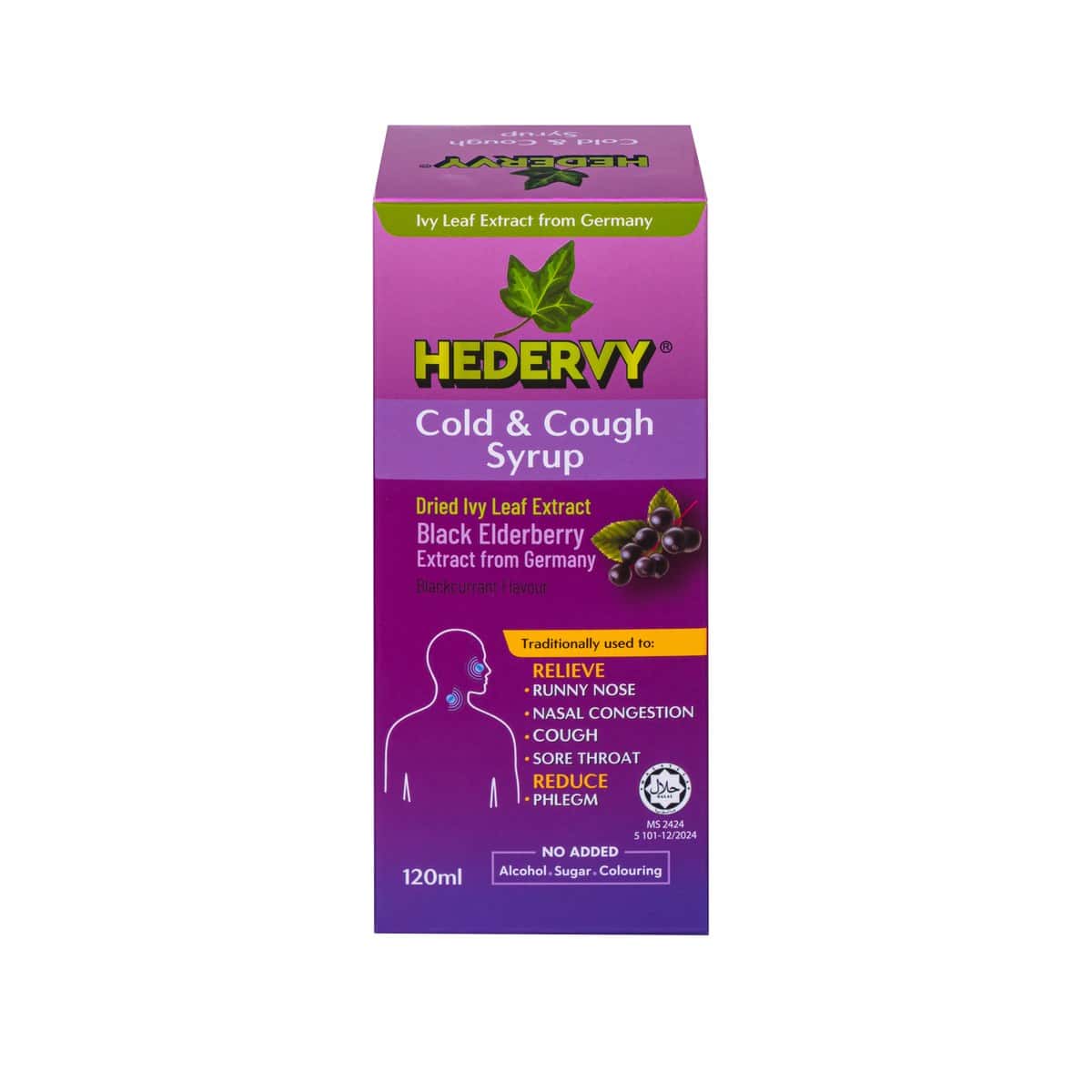
If a blocked nose really is your only symptom and there’s no cough at all, treat the nose directly with steam and saline.
Which syrup for which symptom · Pharmacies that stock it
References
The numbered sources below correspond to the bracketed numbers in the article.
[1] Kahana-Zweig R, et al. / Rhinology Online. The nasal cycle: a comprehensive review. (The turbinates are covered by erectile tissue; the nasal cycle is a subconscious alternating partial congestion and decongestion of the nasal cavities driven by changes in blood volume in the nasal mucosa, alternating roughly every 2 to 6 hours in most adults, and not normally perceived because total nasal airway resistance stays steady.) https://www.rhinologyonline.org/Rhinology_online_issues/manuscript_16.pdf
[2] Rhinitis Medicamentosa. StatPearls [Internet]. Treasure Island (FL): StatPearls Publishing. (Nasal saline irrigation used as an adjunctive measure may improve symptoms and reduce medication use, particularly in patients with frequent rhinitis; over-the-counter saline sprays may help open the nose without causing rhinitis medicamentosa provided they contain no decongestant.) https://www.ncbi.nlm.nih.gov/books/NBK538318/
[3] Rhinitis Medicamentosa. StatPearls [Internet]. (Rhinitis medicamentosa, commonly referred to as rebound congestion, is inflammation of the nasal mucosa caused by excessive use of topical nasal decongestants, arising when decongestant sprays are used for more than a few days and leading to swelling of the nasal passages and persistent stuffiness.) https://www.ncbi.nlm.nih.gov/books/NBK538318/
[4] European Medicines Agency (Committee on Herbal Medicinal Products). European Union herbal monograph on Hedera helix L., folium. (Ivy leaf preparations are recognised as an expectorant for productive cough, for adults, adolescents and children from 2 years of age.) https://www.ema.europa.eu/en/medicines/herbal/hederae-helicis-folium
Last updated 2026-07-28. This article is for general information only and is not a substitute for medical advice. For severe or persistent symptoms, see a doctor.