
Quick answer: Choosing a cough syrup for a child comes down to two things together. The ingredient tells you whether it suits the type of cough. The age band on the pack tells you whether your child can take it, and how much. A wet, phlegmy cough calls for an expectorant; a dry, tickly cough calls for something different, and that’s a conversation to have with a pharmacist for a young child. Below age 2, cough syrup generally isn’t the answer. From 2 years, an ivy leaf expectorant such as Hedervy Apple Flavour Cough Syrup is dosed by the pack. Above that, the label and a pharmacist’s advice narrow it down further.
How ivy leaf relieves cough · Hedervy Apple Flavour Cough Syrup
Every parent standing in a Watsons or Guardian aisle at 9pm with a coughing child is trying to answer two questions at once, whether they realise it or not: what kind of cough is this, and what is my child actually old enough to take? Get either one wrong and the syrup either doesn’t help or isn’t appropriate for the age on the box. This guide walks through both, age band by age band, sourced to the product label and to primary health guidance rather than general parenting advice.
One thing to set straight before the age bands: Hedervy is for wet, productive coughs with phlegm.
Its ivy leaf extract is an expectorant, which loosens mucus so a child can cough it up more easily. A dry, hacking cough with no phlegm needs a different kind of product, and nothing below is a recommendation for that kind of cough.
Under 2: Why No OTC Cough Syrup, and What to Do Instead
For a child under 2, there generally isn’t an over-the-counter cough syrup you should be giving them. Hedervy’s label starts at 2 years.
Labels differ on where that line sits. Hedervy follows the EU herbal monograph that recognises ivy leaf (Hedera helix) as a cough expectorant, which covers use “in adults, adolescents and children from the age of 2 years.”1 That’s why Hedervy’s own pack (Apple Flavour, 120ml) starts its dosing table at the 2–5 years band and has nothing listed below it. Some other ivy leaf syrups are labelled from a younger age, so for a child under 2, check the specific pack and ask a pharmacist before giving anything.
More broadly, UK guidance that Singapore parents will often see referenced online takes the same position for over-the-counter cough and cold remedies generally: they shouldn’t be given to children under 6 without a GP or pharmacist’s advice, a category that includes decongestants and many combination products, not ivy leaf syrups specifically.2
For a child under 2 with a cough, keep them well fed and hydrated, let them rest, and ask a pharmacist or GP what is suitable for their age. If the cough is persistent, disrupts feeding or sleeping, or comes with fever, fast breathing, or general unwellness, that’s a reason to see a doctor rather than try to manage it with any product bought off a shelf.
Ages 2 to 5: What Is Safe, and What the Label Allows
From age 2, an ivy leaf expectorant becomes an option for a wet, productive cough, and this is where Hedervy’s Apple Flavour Cough Syrup is labelled to start.
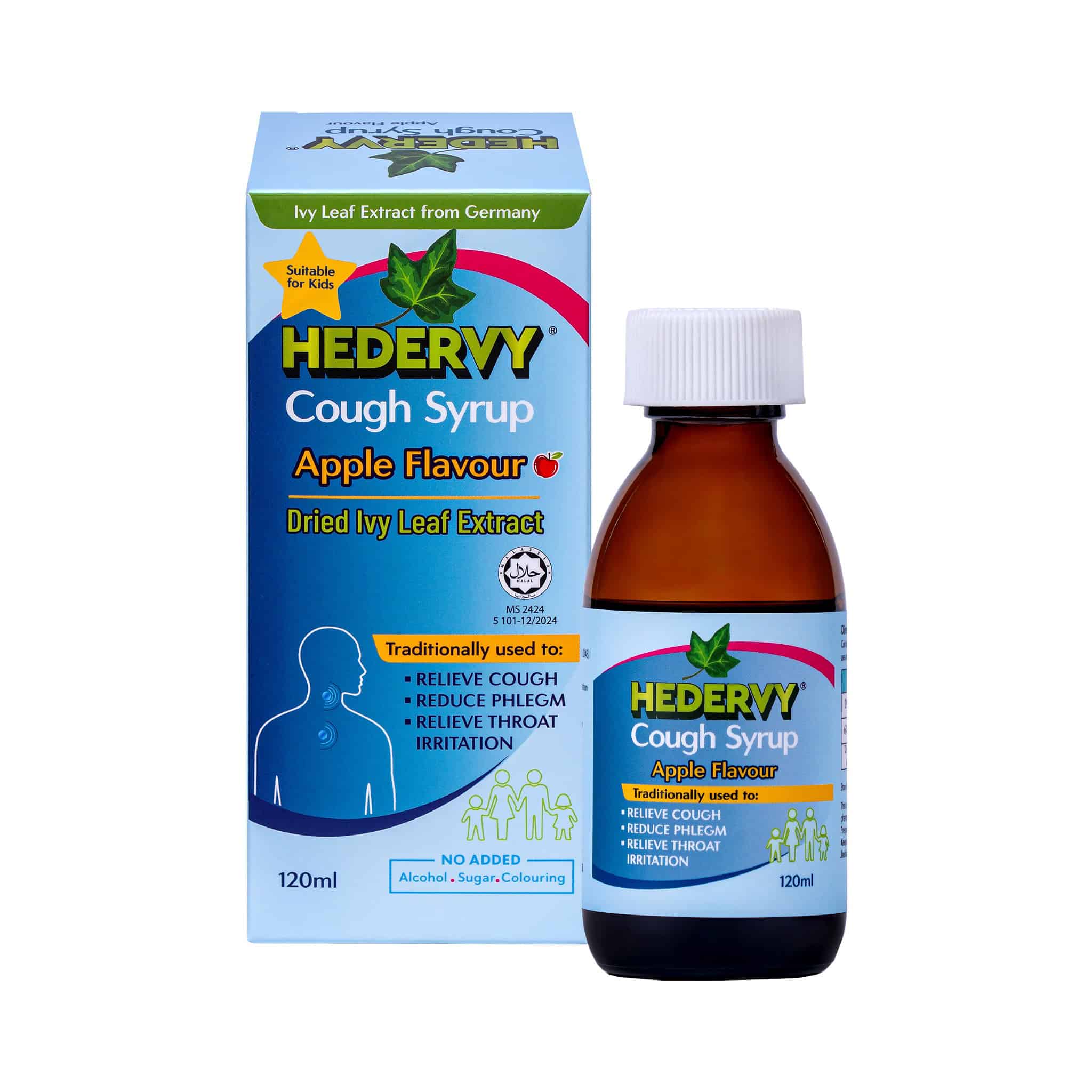
The pack’s own dosing panel gives the 2–5 years band as 2.5ml, twice daily.3 Each 5ml of the Apple Flavour formula contains 35mg of Hedera helix leaf extract, made from dried ivy leaf extract from Germany that complies with European Pharmacopoeia monograph 2148.3 The pack’s stated indications are to relieve cough, reduce phlegm, and relieve throat irritation. That’s traditional-use wording; it makes no claim to cure or shorten an underlying illness.3
At this age, the label matters more than the marketing. Check these on any cough product before it goes anywhere near a 2 to 5 year old:
- Is it single-ingredient or a combination? A simple expectorant like ivy leaf is easier to reason about than a multi-ingredient cold-and-flu product that also contains a decongestant or antihistamine, because you’re only managing one active ingredient’s effects, not several at once.
- Does the pack list this age band? Not every cough syrup on the shelf is labelled down to age 2. If the box doesn’t show a 2–5 years dose, that’s the signal to ask the pharmacist rather than estimate from the adult dose.
- Sugar, alcohol, colouring. Worth checking for any child, but especially relevant if there’s a family history of sensitivities. Hedervy’s Apple Flavour has none of the three added.
Ages 6 to 11: What Changes, and the School-Day Question
For an ivy leaf syrup like Hedervy, the step up from the 2–5 band is a larger dose of the same active ingredient. The pack lists the 6–11 years band at 5ml, twice daily.3
What changes at this age is the school-day question: can my child take this and still function in class? Ivy leaf is an expectorant and isn’t sedating, so it doesn’t carry the drowsiness of some cold-and-flu combination products.
Know this before the pharmacy visit. If a product’s active ingredient is an antihistamine (commonly used for a runny nose or to help a child sleep through congestion), drowsiness is the trade-off. Weigh that against a school morning. An expectorant alone doesn’t carry it.
The other 6–11 consideration is dose accuracy. At 5ml, small measuring errors matter less proportionally than they do at the 2.5ml dose for younger children, but the advice is the same either way: use the measuring cup that comes in the box, not a kitchen teaspoon, and shake the bottle before every dose.3
When to Ask a Pharmacist First
Two categories are worth asking a pharmacist or doctor about before giving them to a child, because they don’t work the way an expectorant does.
Pharmacy-only, stronger cough syrups. Products containing dextromethorphan (a cough suppressant, used for dry coughs) or codeine sit behind the pharmacy counter for a reason. Singapore’s Health Sciences Authority restricts codeine-containing cough products because of paediatric safety concerns. Codeine for cough relief is recommended only from age 12 and above, and it isn’t recommended for post-operative pain in anyone under 18. HSA has recorded local reports of serious breathing-related side effects (difficulty breathing and wheeze-type reactions) in children as young as 9 who were given codeine-containing cough products.4
For a child of any age under 12, that’s a conversation for the pharmacist counter.
Antihistamine combination products. These are often marketed for a runny nose alongside a cough, and the antihistamine component is what causes the drowsiness discussed above. They’re not automatically wrong for a child, but the sedating effect, and interactions with anything else the child might be taking, are exactly what a pharmacist is there to check.
Neither category is ruled out. Both just need a pharmacist or doctor’s input for a child, which a plain age-labelled expectorant doesn’t.
A children’s dose that’s a fraction of the adult dose is completely normal. Look at Hedervy’s own Apple Flavour chart: 2.5ml for 2–5 years, 5ml for 6–11 years, versus 7.5ml for 12 years and up, each taken more or less often depending on the age band.3 Smaller doses for younger children, more frequent or larger doses as they get older: that’s simply how children’s medicine is designed.
Dosing, By the Pack
For reference, here is the Apple Flavour Cough Syrup dosing chart exactly as printed on the box:3
| Age | Dose | Frequency |
|---|---|---|
| 2–5 years | 2.5ml | Twice daily |
| 6–11 years | 5ml | Twice daily |
| 12 years to adult | 7.5ml | Three times daily |
Each 5ml contains 35mg of Hedera helix (ivy leaf) extract. Use the measuring cup provided, shake well before use, and it can be taken with or without food. The pack directs anyone whose symptoms persist or worsen to consult a pharmacist or doctor, and notes insufficient reliable data for use during pregnancy or breastfeeding.3
Comparing Cough Ingredients by Age Band
No single ingredient is right for every child at every age. Here’s how the main categories on a Singapore pharmacy shelf line up against age, for a wet, phlegmy cough versus a dry one:
| Age band | Ivy leaf expectorant (e.g. Hedervy) | Guaifenesin (synthetic expectorant) | Dextromethorphan (suppressant, dry cough) | Antihistamine combinations | Honey (home measure) |
|---|---|---|---|---|---|
| Under 2 | Not on Hedervy’s label; ask a pharmacist or doctor | Ask a pharmacist or doctor | Ask a pharmacist or doctor | Ask a pharmacist or doctor | Not under 1; from age 1, in a warm drink |
| 2–5 years | Suitable: 2.5ml twice daily | Ask a pharmacist or doctor about age-appropriate dosing | Ask a pharmacist or doctor | Ask a pharmacist or doctor | Suitable from age 1, in a warm drink |
| 6–11 years | Suitable: 5ml twice daily | Ask a pharmacist or doctor about age-appropriate dosing | Ask a pharmacist or doctor | Ask a pharmacist or doctor | Suitable |
| 12 years+ | Suitable: 7.5ml three times daily | Generally suitable, confirm label dose | Ask a pharmacist, particularly for school or work days | Ask a pharmacist about drowsiness before a school day | Suitable |
The pattern is the same throughout this guide: a labelled expectorant for a wet cough is the simplest category to reason about by age. Anything that suppresses the cough reflex or sedates deserves a pharmacist’s input first.
When a Child’s Cough Needs a Doctor, Not a Syrup
A cough syrup, whatever the ingredient, manages a symptom. It doesn’t treat whatever is causing the cough. For most colds and mild flu, that’s fine, because the cough resolves as the illness does. But some patterns mean a syrup isn’t the right next step. See a doctor if:
- Your child is struggling to breathe, or breathing looks laboured. This needs urgent medical attention: go to a clinic, polyclinic, or A&E rather than waiting.5
- A baby is too breathless to feed, or is showing pauses in breathing, grunting, or a harsh sound on breathing in.5
- The cough has lasted more than 3 weeks without easing.5
- A very high fever accompanies the cough. This can point to a chest infection and needs a same-day GP or polyclinic check.5
- A child under 2 has a persistent cough at all. This age group should be assessed rather than managed with an OTC product bought without advice.1
- There’s any blood in what’s coughed up, regardless of how well the child otherwise seems.6
In Singapore, a polyclinic visit or a GP clinic are both reasonable first stops for anything short of a breathing emergency; for a child who’s struggling to breathe, treat it the same way you would any medical emergency and go straight to A&E.
Frequently Asked Questions
What cough syrup is safe for a 3 year old?
A 3 year old falls in the 2–5 years band. For a wet, productive cough, an ivy leaf expectorant labelled for that age (such as Hedervy Apple Flavour Cough Syrup at 2.5ml twice daily) is an appropriate, age-labelled option.3 For a dry cough, or if you’re unsure which type of cough your child has, ask a pharmacist before buying anything.
Can toddlers have ivy leaf cough syrup?
From age 2, yes. Ivy leaf is recognised as suitable for children from 2 years and above under the EU herbal monograph, and that’s the age Hedervy’s own pack starts its dosing chart.1,3 Hedervy’s label starts at 2 years, in line with that guidance. For a child under 2, ask a pharmacist or doctor first.
Which Hedervy flavour is for children?
Apple Flavour is the one we suggest for children, because of its taste, and it’s the flavour the doses in this article are taken from. Original and Cold & Cough carry the same age bands on the pack (2–5, 6–11, and 12 to adult), so check each pack for its dose. If your child’s cough comes with a runny or blocked nose or a sore throat, Cold & Cough adds Black Elderberry extract to the ivy leaf. Its pack says it is traditionally used to relieve runny nose, nasal congestion, cough and sore throat, and to reduce phlegm.
Is ivy leaf cough syrup the same as a regular cough suppressant?
No. Ivy leaf is an expectorant: it loosens phlegm so a wet cough clears more easily. A suppressant, like dextromethorphan, quiets the cough reflex and is used for dry coughs instead. Giving an expectorant for a dry cough, or a suppressant for a wet one, is a common mix-up at the pharmacy shelf, and one a pharmacist can sort out in a minute.
Is it normal that my child’s dose is so much smaller than an adult’s?
Yes. Smaller doses for younger children are the normal way children’s medicine is designed. Hedervy’s own chart shows this directly: 2.5ml for 2–5 years, up to 7.5ml for 12 years and adult.3
Where Hedervy fits
Hedervy Apple Flavour Cough Syrup is formulated for wet, productive coughs with phlegm in children from 2 years and above, with a dosing chart printed directly on the pack for the 2–5, 6–11, and 12-plus age bands. It’s Halal-certified (MS 2424) and contains no added alcohol, sugar, or artificial colouring. For a dry, tickly cough, or for any cough in a child under 2, ask a pharmacist instead.
Read how ivy leaf relieves cough, or view Hedervy Apple Flavour Cough Syrup directly.
References
The numbered sources below correspond to the superscript numbers in the article. Every clinical or dosing claim is cited to a primary source or to the product’s own packaging.
- European Medicines Agency (Committee on Herbal Medicinal Products). European Union herbal monograph on Hedera helix L., folium. (Ivy leaf medicines are for use in adults, adolescents and children from the age of 2 years.) https://www.ema.europa.eu/en/medicines/herbal/hederae-helicis-folium ↩
- NHS. Colds, coughs and ear infections in children. (Children under 6 shouldn’t be given over-the-counter cough and cold remedies, including decongestants, unless advised to by a GP or pharmacist; a warm honey and lemon drink can help children over 1.) https://www.nhs.uk/baby/health/colds-coughs-and-ear-infections-in-children/ ↩
- Hedervy Apple Flavour Cough Syrup, 120ml — product packaging (dosing panel and active-ingredient/indications panel), supplied by Hedervy, 2026-05-08. Active ingredient: 35mg Hedera helix leaf extract per 5ml, dried ivy leaf from Germany, complying with Ph. Eur. monograph 2148. Dosing: 2–5 years 2.5ml twice daily; 6–11 years 5ml twice daily; 12 years to adult 7.5ml three times daily. Indications: traditionally used to relieve cough, reduce phlegm, and relieve throat irritation. ↩
- Health Sciences Authority (HSA), Singapore. Restrictions on the use of codeine-containing products in children and adolescents. (Codeine for cough relief is recommended only for patients aged 12 years and above, at the lowest effective dose for the shortest duration; not recommended for post-operative pain in those under 18; HSA has received local reports of respiratory adverse events, including difficulty breathing and bronchospasm, in children aged 9–16 given codeine-containing cough products.) https://www.hsa.gov.sg/announcements/restrictions-on-the-use-of-codeine-containing-products-in-children-and-adolescents/ ↩
- NHS. Colds, coughs and ear infections in children. (See a GP if a cough has lasted more than 3 weeks, or contact a GP/111 for a very high temperature; go to A&E or call 999 immediately if a child is finding it hard to breathe, or if a baby is too breathless to feed, has pauses in breathing, or is grunting.) https://www.nhs.uk/baby/health/colds-coughs-and-ear-infections-in-children/ ↩
- NHS. Cough. (Get an urgent GP appointment or call 111 if you are coughing up blood.) https://www.nhs.uk/conditions/cough/ ↩
Last updated 2026-09-28. This article is for general information only and is not a substitute for medical advice. For a child under 2, or if you’re at all unsure, speak to a pharmacist or doctor before giving any cough product. For severe or persistent symptoms, see a doctor.