

Quick answer: Green phlegm usually means your immune system is actively fighting an infection. Most often that is a common cold or flu virus, not a bacterial one. On its own, green does not mean you need antibiotics. It typically clears in 1–2 weeks alongside the rest of a cold. What matters more than the colour is how you feel: green phlegm with a high fever, breathlessness, or symptoms lasting past three weeks is the signal to see a doctor.
How to clear phlegm and a productive cough · See cough syrups for a chesty cough · Find Hedervy at a pharmacy
Coughing up green phlegm looks alarming, and most people read it as “I’ve got an infection, I need antibiotics.” The colour is real information, but it doesn’t mean what most people assume. This guide explains what green phlegm actually is, why the popular “green equals bacterial” belief is wrong, how long it should last, how to clear it faster, and the specific signs that mean it’s time to see a GP rather than manage it at home.
What the Colour of Phlegm Actually Tells You
Phlegm changes colour through a normal illness, and each shade is a rough clue rather than a diagnosis.
| Colour | What it usually means | What to do |
|---|---|---|
| Clear | Normal, or the early stage of a cold or allergy | Hydrate; watch for other symptoms |
| White / cloudy | Congestion; often the start of a viral cold | Rest, fluids, steam |
| Yellow | Immune cells arriving; your body has started fighting the infection | Normal mid-cold; keep managing at home |
| Green | A later, more active immune response, with more immune cells in the mucus | Usually still viral; manage at home, watch the red flags below |
| Brown / rusty | Old blood, or irritation from smoking or haze | See a GP if persistent or you’re a smoker |
| Pink / red | Fresh blood in the phlegm | See a doctor; any amount of blood warrants a check |
The key point: yellow and green sit on the same spectrum. Phlegm often goes clear, white, yellow, then green over the course of a normal cold, then fades back as you recover. Green is simply a more concentrated version of the same immune activity that turns phlegm yellow.
Why Phlegm Turns Green
The colour doesn’t come from bacteria. It comes from your own immune cells.
When your body detects an infection, it sends white blood cells called neutrophils to the site. These cells contain a green-tinted enzyme (myeloperoxidase).1 As they arrive in large numbers, break down, and get cleared out in your mucus, they tint the phlegm yellow, then green. More immune cells, deeper green — the depth of the colour tracks how many neutrophils are in the mucus, not how many bacteria.2
So green phlegm is the visible by-product of your immune system doing its job. It tells you an infection is present and being fought, but it does not tell you whether that infection is viral or bacterial, and it doesn’t tell you that you need medication to kill it.
Does Green Phlegm Mean You Need Antibiotics?
Usually not. This is the single most common misunderstanding about phlegm colour.
The large majority of coughs with green or yellow phlegm are caused by ordinary viruses: colds, flu, and viral bronchitis. Antibiotics do nothing against viruses. Research bears this out. In a primary-care study of 241 patients with an acute cough, only about 16% of those coughing up yellow or green phlegm actually had a bacterial infection, so the colour simply wasn’t a reliable signal. The authors concluded that in otherwise-healthy adults, sputum colour cannot tell a viral infection from a bacterial one.3
The UK’s National Institute for Health and Care Excellence (NICE) lands in the same place. Its acute-cough guidance found that patients with green sputum were no more likely to benefit from antibiotics than anyone else, and it advises against antibiotics for an acute cough in people who are not systemically very unwell.4 This is why a careful GP won’t prescribe antibiotics on colour alone, and why taking antibiotics you don’t need is discouraged: it fuels antibiotic resistance, a concern Singapore’s health authorities actively flag.5
(One exception: if you have a chronic lung condition such as bronchiectasis or COPD, phlegm colour carries more weight and should be discussed with your doctor. The guidance above is for otherwise-healthy adults with an ordinary cough.)
What actually points toward a bacterial infection that might need a doctor’s assessment is the overall picture, not the colour: a high fever that persists or returns, symptoms that get worse after initially improving, breathlessness or chest pain, or a cough dragging past three weeks. Those are covered in the red-flags section below.
How Long Does Green Phlegm Last?
For a typical cold or flu in Singapore, green or yellow phlegm shows up in the middle-to-later part of the illness and clears within 1–2 weeks as you recover. A residual cough with occasional discoloured phlegm can linger a little longer after the infection itself has passed, especially following flu or acute bronchitis.
Recovery looks like this: the phlegm thinning, the colour fading back toward white or clear, coughing becoming less frequent, and your energy returning. If instead the green phlegm is getting thicker, more frequent, or is joined by a rising fever after you’d started to feel better, that’s the pattern that warrants a GP visit rather than more time at home.
How to Clear Green Phlegm Faster
The colour clears as the infection resolves, but you can help your body shift the mucus more comfortably. The first three are free and start working within hours.
Hydrate with warm fluids. Warm water, ginger tea, and broth-based soups thin mucus from the inside so it’s easier to bring up. Avoid ice-cold drinks while you’re congested.
Steam inhalation, twice a day. A hot shower works, or a bowl of just-boiled water with a towel over your head, breathing slowly for 5–10 minutes.
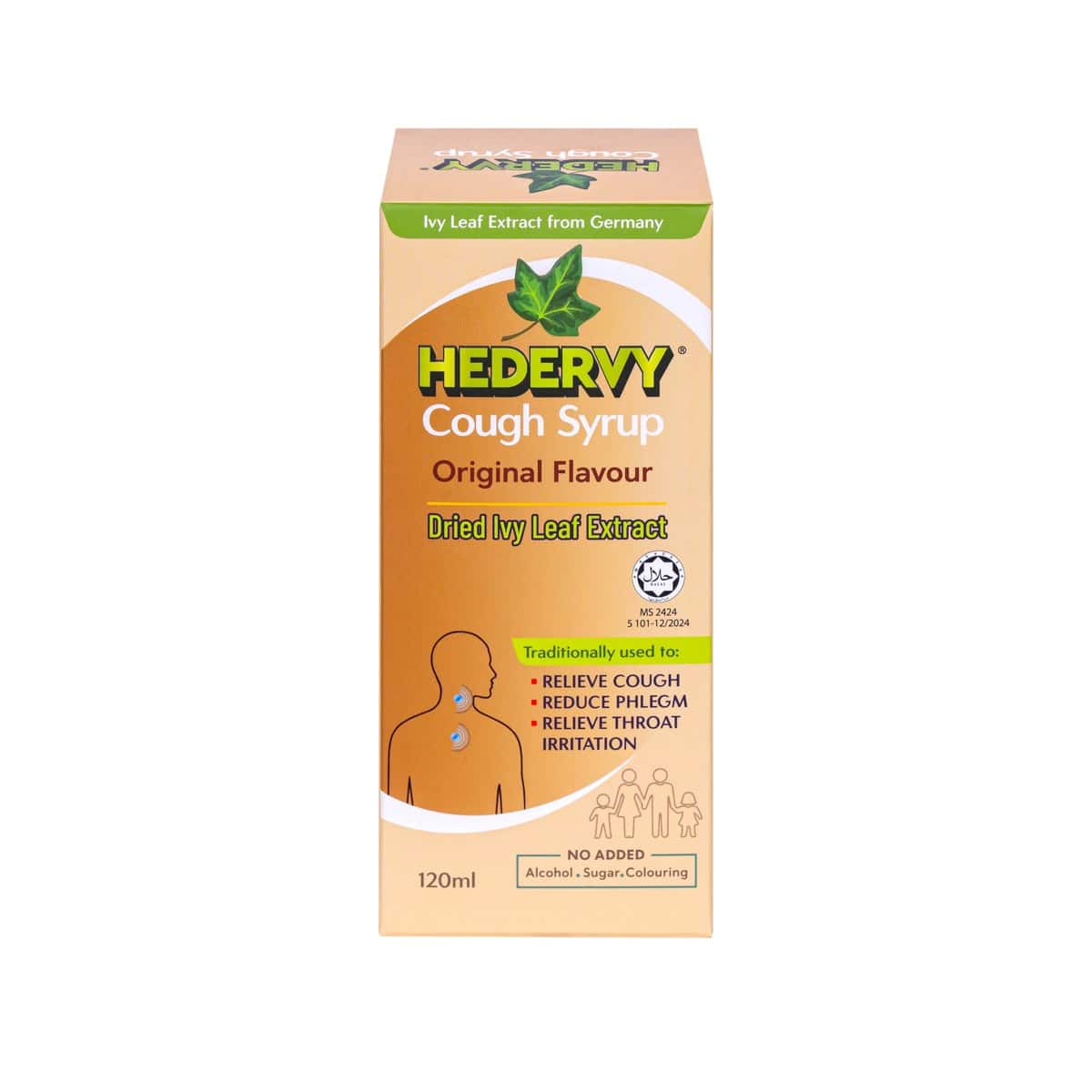
Use an expectorant when the phlegm is stubborn. Green phlegm is a productive (chesty) cough, so an expectorant, which thins mucus so your body can clear it, is the right class rather than a suppressant (which traps it). Ivy leaf extract (Hedera helix) is a plant-based expectorant recognised by the European Medicines Agency as an expectorant for productive cough, suitable from age 2, with documented action in clinical trials.6 It’s the active in Hedervy Original / Apple Flavour Cough Syrup, and in Hedervy Cold & Cough Syrup (ivy leaf plus Black Elderberry). Plant-based, Halal-certified (MS 2424), with no added alcohol, sugar, or colouring, and suitable for adults and children aged 2 years and above.
Honey in warm water eases the throat for adults and children over 1 (never under 1).7 And sleeping with your head elevated stops mucus pooling overnight, which is what drives the thick morning phlegm.
For the full step-by-step on shifting phlegm, see our guide on how to get rid of phlegm.
When Green Phlegm Means See a Doctor
Green on its own isn’t the alarm; plenty of ordinary colds pass through a green phase. The alarm is green phlegm plus one of these:8
Green streaked with blood. Any pink, red, or rusty tinge in the phlegm, not just green, is worth a same-week check, regardless of how you otherwise feel.
Green that outlasts three weeks, or thickens after you’d started improving. Green phlegm should be fading back toward white as you recover. If it’s still green (or getting darker and thicker) past the three-week mark, or comes roaring back after a few better days, that reversal is the signal, not the colour itself.
Green with a fever above 39°C that won’t settle. A short, low fever alongside green phlegm is unremarkable. A high fever that persists for several days, or disappears and then returns, points to something your body needs help clearing.
Green with breathlessness or chest pain. These aren’t phlegm symptoms. They mean the infection may have moved into the airways or lungs, and green phlegm alongside them changes the picture entirely.
A child under 2 with green phlegm. At this age, a persistent productive cough should be assessed by a doctor rather than managed at home, whatever the colour.
Green phlegm in someone with asthma or COPD that isn’t following the usual pattern. In these conditions the colour carries more diagnostic weight, so green phlegm that isn’t clearing as expected warrants a call to your doctor rather than a wait-and-see.
Singapore options: polyclinic (subsidised; confirm current rates), private GP, or telehealth for milder assessments. For severe breathlessness or chest pain, go to A&E.
Frequently Asked Questions
Is green phlegm a sign of a cold or a bacterial infection?
Most often a cold or flu virus. Green phlegm is caused by immune cells (neutrophils) gathering in the mucus, which happens with viral infections too. The colour alone can’t tell you whether it’s viral or bacterial; that’s judged from the whole picture, like fever, duration, and whether you’re getting better or worse.
Do I need antibiotics for green phlegm?
Usually not. The colour is a poor predictor of bacterial infection, and antibiotics don’t work on the viruses that cause most coughs. A doctor decides based on your overall symptoms, not the colour. See a GP if you have a high or returning fever, breathlessness, or a cough lasting more than three weeks.
Is green phlegm contagious?
The phlegm itself isn’t the issue; the underlying cold or flu virus is what spreads, mainly through coughing, sneezing, and hands. Wash hands, cover coughs, and stay home when unwell. Whether you’re contagious depends on the infection, not the colour of the mucus.
I have green phlegm but no fever — should I worry?
Green phlegm with no fever, where you’re otherwise improving, is usually just a normal later stage of a cold clearing up. Keep hydrating, use an expectorant if the cough is productive, and monitor. See a doctor if it lasts beyond three weeks or new symptoms appear.
Why is my green phlegm worse in the morning?
Mucus pools in the airways and throat overnight when you lie flat, so the first cough of the day clears what built up. Sleeping with your head raised, and a warm drink first thing, usually settles the morning cough.
Can children cough up green phlegm?
Yes, and it’s usually the same viral cold pattern as in adults. For children aged 2 and above with a productive cough, ivy leaf-based syrups are a common Singapore choice. For under-2s, see a pharmacist or GP before any cough product. Any child with green phlegm plus a high fever, fast breathing, or breathlessness should be seen by a doctor.
Where Hedervy fits
Green phlegm means a productive cough, and that is what Hedervy is made for. Its ivy leaf extract is a clinical-evidence-backed natural expectorant that thins mucus so your body can clear it. Halal-certified (MS 2424), free from added alcohol, sugar, and artificial colouring, and suitable for adults and children aged 2 and above. The Cold & Cough variant adds Black Elderberry from Germany and is traditionally used to relieve runny nose, nasal congestion, cough, sore throat, and reduce phlegm. Stocked at Watsons, Guardian, Unity, NHG Pharmacy, and Raffles Health.
See the range at hedervy.com, or use the pharmacy locator to find a stockist near you.
References
The numbered sources below correspond to the superscript numbers in the article. Every medical claim is cited to a primary source.
- Klebanoff SJ, Kettle AJ, Rosen H, Winterbourn CC, Nauseef WM. Myeloperoxidase: a front-line defender against phagocytosed microorganisms. Journal of Leukocyte Biology, 2013;93(2):185–198. (Myeloperoxidase is the green heme-containing enzyme carried by neutrophils.) https://pmc.ncbi.nlm.nih.gov/articles/PMC3545676/ ↩
- Simpson JL, et al. Sputum colour can identify patients with neutrophilic inflammation. European Respiratory Journal / ERJ Open Research. (Sputum colour tracks neutrophil and myeloperoxidase content, not the presence of bacteria.) https://pmc.ncbi.nlm.nih.gov/articles/PMC5640107/ ↩
- Altiner A, Wilm S, Däubener W, Bormann C, Pentzek M, Abholz H-H, Scherer M. Sputum colour for diagnosis of a bacterial infection in patients with acute cough. Scandinavian Journal of Primary Health Care, 2009;27(2):70–73. PMID 19242860. (Positive predictive value of yellow/green sputum for bacterial infection: 0.16, i.e. about 16%.) https://pmc.ncbi.nlm.nih.gov/articles/PMC3410464/ ↩
- National Institute for Health and Care Excellence (NICE). Cough (acute): antimicrobial prescribing. NICE guideline NG120, published 7 February 2019. (No pre-specified subgroup, including patients with green sputum, was more likely to benefit from antibiotics; antibiotics are not recommended for acute cough in people who are not systemically very unwell.) https://www.nice.org.uk/guidance/ng120 ↩
- HealthHub Singapore (Ministry of Health). Use Antibiotics Right. (Antibiotics do not work against the viruses that cause colds, cough, and flu; misuse drives antibiotic resistance.) https://www.healthhub.sg/programmes/use-antibiotics-right ↩
- European Medicines Agency (Committee on Herbal Medicinal Products). European Union herbal monograph on Hedera helix L., folium. (Ivy leaf preparations are recognised as an expectorant for productive cough, for adults, adolescents, and children from 2 years of age.) https://www.ema.europa.eu/en/medicines/herbal/hederae-helicis-folium ↩
- NICE guideline NG120 (as above) lists honey as a self-care option for acute cough in people aged over 1 year. Honey should never be given to infants under 1 year. ↩
- NHS. Cough. (A cough usually clears within 3 to 4 weeks; seek medical advice for a cough lasting more than 3 weeks, coughing up blood, chest pain, or difficulty breathing.) https://www.nhs.uk/conditions/cough/ ↩
Last updated 2026-07-13. This article is for general information only and is not a substitute for medical advice. For severe or persistent symptoms, see a doctor.