

Quick answer: Phlegm is thick mucus in your chest. The medicine that clears it is an expectorant (or a mucolytic). It thins the mucus so a normal cough can bring it up. A suppressant does the opposite. It quiets the urge to cough, which is the wrong job for a wet, phlegmy cough because it can leave the mucus sitting in your chest.2,3
Ivy leaf extract, guaifenesin, and bromhexine are the expectorant/mucolytic options sold over the counter in Singapore. Dextromethorphan is the common suppressant. If your cough is already bringing up phlegm, ask a pharmacist or doctor about it first.3
How to get rid of phlegm (home-care steps) · Full cough syrup guide · Find Hedervy at a pharmacy
Standing at Watsons or Guardian with a chesty cough, the shelf doesn’t make the choice easy. Boxes promise to “clear mucus,” “quiet coughs,” or “relieve chest congestion,” and unless you know what the active ingredient actually does, one bottle looks as good as the next.
Phlegm medicines split into two jobs that work against each other. Pick the wrong one and you’re working against what your chest is trying to do.
This guide skips the home-care steps (those are covered in our how to get rid of phlegm guide) and goes straight to the medicine cabinet: what an expectorant actually does, how it differs from a mucolytic and a suppressant, how the common Singapore options compare, and the point at which phlegm stops being a shelf decision and needs a doctor.
How an Expectorant Like Ivy Leaf Works
An expectorant’s job is narrow and mechanical: it thins the mucus sitting in your airways so your own cough can move it out. The phlegm you already have gets easier to clear. The virus and the length of the illness stay the same.
Ivy leaf extract (Hedera helix) is the plant-based expectorant in Hedervy Original / Apple Flavour Cough Syrup. It carries a European Medicines Agency herbal monograph recognising it as an expectorant for productive (chesty) cough, based on well-established use (bibliographic evidence spanning more than ten years within the EU).
Adult trials cited in that assessment found ivy leaf reduced cough severity more than placebo. A paediatric trial found its effect on acute bronchitis symptoms in children comparable to a standard mucolytic (acetylcysteine).1 It’s approved for adults, adolescents, and children from age 2.1
Mucolytics work differently. Bromhexine and N-acetylcysteine (NAC) are the two sold over the counter in Singapore. Where an expectorant thins mucus, a mucolytic breaks down the chemical bonds holding thick mucus together. When phlegm is especially stubborn or sticky, a pharmacist may suggest adding one to an expectorant.
The synthetic expectorant most people will recognise from imported pharmacy brands is guaifenesin. Its own drug facts label states its purpose: an expectorant that “helps loosen phlegm (mucus) and thin bronchial secretions to make coughs more productive.”2
Before you rely on it, know that the clinical evidence behind guaifenesin is mixed. A Cochrane-indexed review of over-the-counter cough medicines found trial results inconsistent, with some studies showing a clear benefit over placebo and others showing none. It concluded there wasn’t enough high-quality data to say definitively how well it works.4 That doesn’t mean it’s ineffective. It means the evidence is thinner than most people assume from the packaging.
Medicine Options Compared: Expectorant vs. Suppressant vs. Combination
The most useful thing you can do before choosing a medicine is name your cough correctly. A productive (wet) cough brings up mucus: your chest feels heavy, and you can feel something move when you cough. A dry cough is tickly and brings up nothing. Phlegm means you have the first kind, and that decides which shelf to shop from.
| Medicine class | What it does | Best for | Common actives (Singapore) | HSA class |
|---|---|---|---|---|
| Expectorant | Thins mucus so a normal cough clears it | Wet cough with phlegm | Ivy leaf extract, guaifenesin | GSL / Traditional Medicine5 |
| Mucolytic | Breaks down thick mucus structure | Stubborn, sticky phlegm | Bromhexine, N-acetylcysteine | GSL5 |
| Suppressant | Quiets the cough reflex itself | Dry, tickly cough disrupting sleep | Dextromethorphan | Pharmacy-only (P)5 |
| Combination | Expectorant/mucolytic paired with a suppressant, decongestant, or antihistamine in one bottle | Multiple symptoms at once (read the label for which job dominates) | Varies by product | Varies by active |
The mismatch matters. An expectorant on a dry cough has little to work with. There’s no mucus to loosen, so it mostly just sits there. A suppressant on a wet cough is the costlier mistake: it dulls the urge to cough at the exact moment your body needs that cough to clear mucus from the chest.
Dextromethorphan’s own drug facts label reflects this. It tells users to check with a doctor before use if their “cough occurs with too much phlegm (mucus).”3 That caution is printed on the suppressant’s own packaging.
On combination products: some cough medicines pair an expectorant with a suppressant in a single bottle, aimed at a cough that’s part dry, part wet, or that’s kept someone up at night despite bringing up mucus. If you’re not sure which ingredient is doing the work in a combination product, that’s exactly the kind of question a pharmacist at Watsons, Guardian, or Unity is there to answer. Checking the label for you takes under a minute.
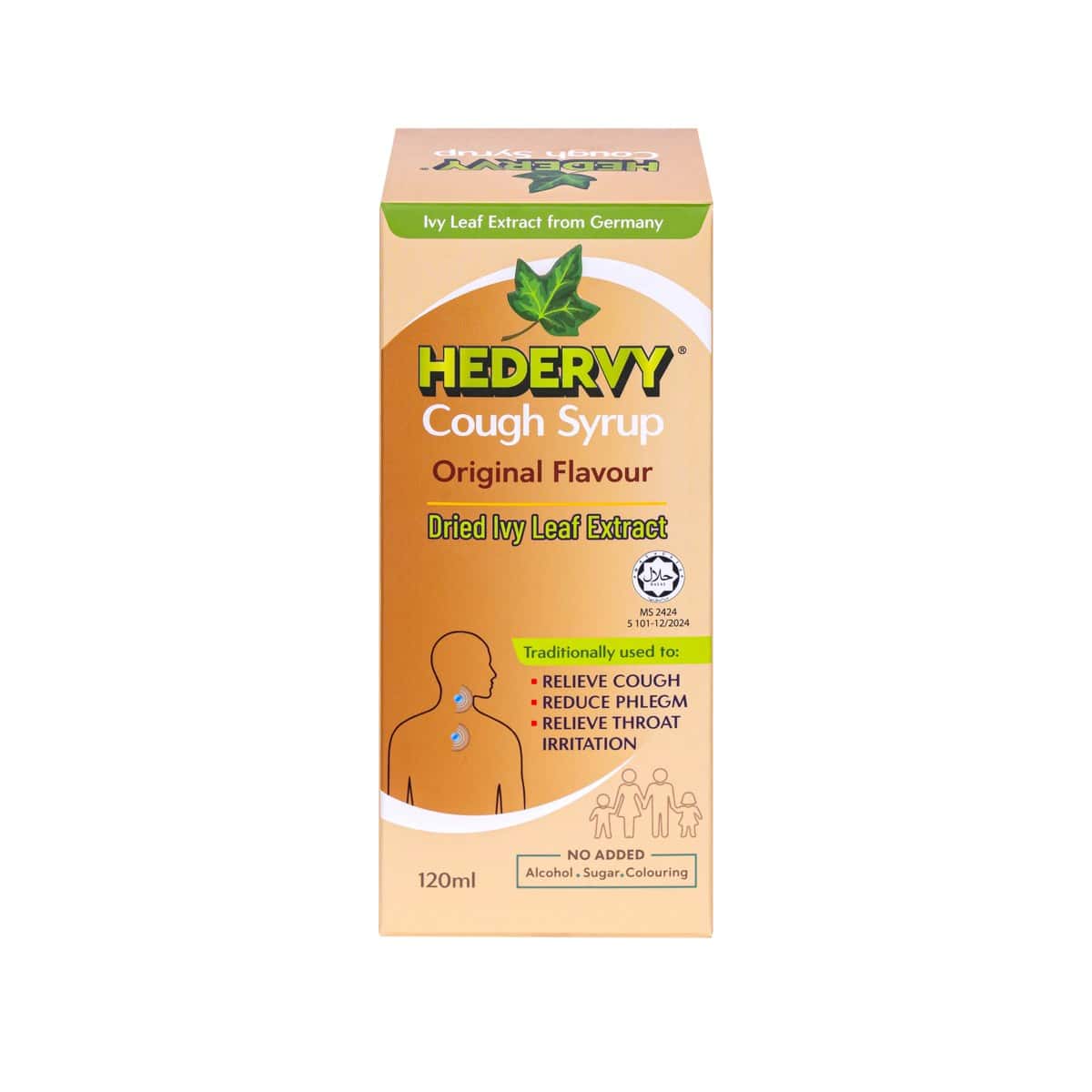
Where Hedervy sits: Hedervy’s syrups are ivy leaf expectorants. They’re single-ingredient in Original and Apple Flavour, and ivy leaf with Black Elderberry in Cold & Cough. None of them contains a suppressant.
They’re formulated for the wet, phlegmy cough this article is about, plant-based, Halal-certified (MS 2424), free of added alcohol, sugar, and colouring, and suitable for adults and children aged 2 years and above. They can soothe an irritated or sore throat but they aren’t the right tool for a dry, non-productive cough. That’s a different job, covered in the full cough syrup guide.
When Phlegm Needs More Than Medicine
Medicine, home care, or both: none of it replaces watching for the signs that phlegm has moved past a routine cold. The colour of phlegm is a weaker signal than most people think. Green phlegm is usually still just an active immune response to an ordinary viral cold, not proof of a bacterial infection needing antibiotics.6 What matters more is the overall pattern.
See a doctor if:
- Phlegm lasts more than 3 weeks, or gets worse after you’ve started improving. A cough usually clears within 3 to 4 weeks on its own; one that drags past that point, or reverses course, needs a look.7
- You see blood in the phlegm, any amount, any colour it’s mixed with.
- A high fever (above 39°C) persists or returns after a few better days.
- You’re breathless, or have chest pain, which are signs the infection may have moved beyond the airways.
- A child under 2 has a persistent productive cough. This age group should be assessed by a doctor rather than managed with an OTC product.
- You have asthma or COPD and the pattern isn’t following its usual course.
Each of these is the point where medicine hands off to a diagnosis, and a different cough medicine won’t change that. Singapore options: polyclinic, private GP, or a telehealth consult for milder cases; A&E for severe breathlessness or chest pain.
Antibiotics don’t help here unless a doctor confirms a bacterial cause. Most productive coughs, including ones with green or yellow phlegm, are viral, and taking antibiotics you don’t need contributes to antibiotic resistance, a concern Singapore’s own health authorities actively flag.8
Frequently Asked Questions
What medicine gets rid of phlegm fast?
There’s no medicine that clears phlegm instantly. It works by helping your own cough do the job faster. An expectorant like ivy leaf or guaifenesin, combined with the home-care steps in our how to get rid of phlegm guide (warm fluids, steam), is the fastest realistic combination. Most productive coughs clear within 7–10 days either way.
Does ivy leaf syrup work on phlegm?
Yes. Ivy leaf is recognised by the European Medicines Agency as an expectorant for productive cough, with clinical trial evidence behind that classification, including in children from age 2.1 It’s the active ingredient in Hedervy’s Original, Apple Flavour, and Cold & Cough syrups, and it’s built specifically for a wet, phlegmy cough rather than a dry one.
What’s the difference between an expectorant and a suppressant?
An expectorant thins mucus so you cough it up more easily. A suppressant reduces the cough reflex itself, which is useful for a dry cough disturbing sleep but is the wrong tool once phlegm is involved. The suppressant’s own label says to check with a doctor first if the cough brings up mucus.3
Can I take an expectorant and a suppressant together?
Some combination products do exactly this, usually to cover a cough that changes character through the day. If you’re unsure whether that fits your symptoms, ask a pharmacist before combining two single-ingredient products yourself. They can check for overlapping active ingredients and confirm the dose.
Can I take a mucolytic with an expectorant?
Ask a pharmacist first. They work in different ways: an expectorant thins mucus, and a mucolytic (bromhexine, N-acetylcysteine) breaks down the mucus structure itself. For particularly thick or stubborn phlegm, a pharmacist may suggest using the two together. Both are sold over the counter in Singapore.5
Where Hedervy fits
If your cough is bringing up phlegm, that’s a job for an expectorant, and Hedervy’s ivy leaf syrups are built for exactly that: plant-based, clinical-evidence-backed, Halal-certified (MS 2424), free from added alcohol, sugar, and artificial colouring, and suitable for adults and children aged 2 and above. The Cold & Cough variant adds Black Elderberry and is traditionally used to relieve runny nose, nasal congestion, cough, sore throat, and reduce phlegm.
See the range at the cough syrup guide, or use the pharmacy locator to find a stockist near you.
References
The numbered sources below correspond to the superscript numbers in the article. Every pharmacological claim is cited to a primary source.
- European Medicines Agency (Committee on Herbal Medicinal Products). European Union herbal monograph on Hedera helix L., folium. (Ivy leaf preparations recognised as an expectorant for productive cough on the basis of well-established use, adults/adolescents/children from age 2; adult trials showed superiority over placebo on cough severity; a paediatric trial found effects comparable to a standard mucolytic.) https://www.ema.europa.eu/en/medicines/herbal/hederae-helicis-folium ↩
- DailyMed (U.S. National Library of Medicine). Guaifenesin — OTC drug facts label. (Purpose: Expectorant. Uses: “helps loosen phlegm (mucus) and thin bronchial secretions to make coughs more productive.”) https://dailymed.nlm.nih.gov/dailymed/drugInfo.cfm?setid=2fd702ea-3069-472c-b99e-c527f1375705 ↩
- DailyMed (U.S. National Library of Medicine). Dextromethorphan HBr — Cough Suppressant OTC drug facts label. (Purpose: Cough suppressant, for cough due to minor throat/bronchial irritation. Label instructs users to ask a doctor before use if cough “occurs with too much phlegm (mucus).”) https://dailymed.nlm.nih.gov/dailymed/drugInfo.cfm?setid=f5c57b32-69cb-469e-ad2d-64c00b5e66dc ↩
- Smith SM, Schroeder K, Fahey T. Over-the-counter (OTC) medications for acute cough in children and adults in community settings. Cochrane Database of Systematic Reviews (summarised in PubMed). (Trial results for guaifenesin and other OTC cough agents were mixed; insufficient high-quality evidence to confirm or rule out effectiveness.) https://pubmed.ncbi.nlm.nih.gov/25420096/ ↩
- Health Sciences Authority (HSA), Singapore. Registration of therapeutic products — overview. (Defines Singapore’s three access tiers: Prescription Only Medicine (POM) — from a doctor or pharmacist with a prescription; Pharmacy Only Medicine (P) — from a pharmacist at a retail pharmacy without a prescription; General Sale List (GSL) — from any retailer.) https://www.hsa.gov.sg/therapeutic-products/register/overview/overview — ingredient-level classification (ivy leaf and guaifenesin as GSL/Traditional Medicine, dextromethorphan as Pharmacy-Only) per Hedervy’s cough syrup guide, client-approved. ↩
- This claim (green/yellow phlegm colour is a poor predictor of bacterial infection) is sourced and footnoted in full in our green phlegm meaning article, drawing on a primary-care study (Altiner et al., Scandinavian Journal of Primary Health Care, 2009) and NICE guideline NG120. ↩
- NHS. Cough. (A cough usually clears within 3 to 4 weeks; seek medical advice for a cough lasting more than 3 weeks, coughing up blood, chest pain, or difficulty breathing. OTC cough remedies “will not stop your cough, but may help you cough less.”) https://www.nhs.uk/conditions/cough/ ↩
- HealthHub Singapore (Ministry of Health). Use Antibiotics Right. (Antibiotics do not work against the viruses that cause colds, cough, and flu; misuse drives antibiotic resistance.) https://www.healthhub.sg/programmes/use-antibiotics-right ↩
Last updated 2026-09-28. This article is for general information only and is not a substitute for medical advice. For severe or persistent symptoms, see a doctor.