

Quick answer: For a chesty (productive) cough, the home measures with trial evidence behind them are honey (over age 1), staying well hydrated, and an expectorant when the cough won’t shift on its own. Steam inhalation and “sleeping propped up” are widely recommended and plausible. The trial evidence for steam specifically is thin, and there’s no dedicated cough trial for the sleeping-position tip either. That doesn’t make them useless. It means no one has proven them the way honey has been proven.
Ivy leaf extract, the active ingredient in Hedervy, is a plant-based expectorant with well-established clinical evidence behind it, on top of its long traditional use. A cough lasting more than three weeks, or joined by breathlessness, chest pain, or a high fever, needs a doctor rather than another home remedy.
Managing a chesty, phlegmy cough · How to clear phlegm faster · Why coughs get worse at night
Most cough advice online is a list with no grading attached: steam, honey, ginger, elevate your head, gargle salt water, all presented as equally useful. They aren’t.
Some have been tested in proper trials and hold up. Some are widely recommended by health authorities because they’re sensible and low-risk, even without a dedicated trial behind them. A few are just things people repeat because they did them once and got better anyway, which is what colds do regardless.
This guide sorts a chesty cough’s remedies into those three buckets and explains what “natural” means once you’re standing in a pharmacy aisle. It also says where home care stops being enough.
Home Measures With Evidence Behind Them
Honey. This is the best-evidenced home remedy for cough, by a clear margin. A 2020 systematic review and meta-analysis pooling 14 randomised controlled trials found honey outperformed usual care for combined symptom score, cough frequency, and cough severity in upper respiratory tract infections.1
A separate 2023 review focused specifically on children rated the evidence “low quality”, since most of the individual trials had a risk of bias. It still leaned toward honey helping, especially for cough frequency and sleep quality compared with no treatment.2 Read together, honey is more than folklore, though it won’t cure a cough on its own. A spoonful before bed, or stirred into warm water, is a reasonable thing to try.
The one hard rule: never give honey to a baby under 12 months old. Honey can carry Clostridium botulinum spores, which an infant’s gut can’t yet handle, and this includes honey baked into food.3 Over age 1, it’s fine.
Staying hydrated. Warm fluids (water, clear soup, weak tea) are a standard recommendation from health authorities managing cough and cold symptoms.4 There isn’t a dedicated clinical trial proving fluids shorten a cough. The case for them is mostly physiological, since thinner mucus is easier to bring up, and near-universal medical advice rather than a tested intervention. Fluids are low-effort and low-risk, so they’re a good habit. Just don’t expect them to do the heavy lifting on their own.
An expectorant, when the cough is stubborn. Once a productive cough has phlegm that won’t shift with fluids and time, an expectorant is the next reasonable step. See the section below on when home care stops being enough.
Home Measures That Don’t Hold Up (and Why People Swear By Them Anyway)
Steam inhalation. Most people assume this is obviously helpful, and the evidence doesn’t back that up. A Cochrane review of six trials covering heated, humidified air for the common cold found the results inconsistent, with some trials showing a benefit and others showing none. It concluded there wasn’t enough evidence to recommend it.5
Steam isn’t dangerous, apart from scald risk with very hot water, so keep some distance from the bowl. The warm, moist air can feel soothing in the moment. That’s probably why it persists: it makes your throat feel better right now, and people then credit it for making the cough go away days later, when the cough was likely on the same timeline regardless.
Sleeping propped up. This is a sensible idea, since gravity should help mucus drain rather than pool at the back of the throat overnight. But it hasn’t been tested in a cough trial the way honey has. It’s a mechanism, with no proven result behind it yet. It’s free and low-effort for adults and older children, so the reasoning alone makes it worth trying.
It is not advice for babies, who should always be put to sleep flat on their back. For the fuller version of this (how to prop the bed, rather than just stack pillows), see why coughs get worse at night.
“Sweating it out,” extra vitamin C, single-food cures. These persist mostly because a cold or cough resolving in a week or two happens regardless of what you did in that time, so almost any remedy tried during that window looks like it worked. If they’re harmless and you enjoy them, go ahead. Just don’t expect them to change the course of the illness.
Natural and Herbal Options: What “Natural” Actually Means
“Natural” on a Singapore pharmacy shelf covers a wide range. At one end are remedies with clinical backing, and at the other are ones that are natural in origin but untested for effectiveness. Knowing which is which helps, because “natural” doesn’t stand in for “proven.”
Ivy leaf (Hedera helix) is the clearest example of a natural ingredient with clinical evidence. The European Medicines Agency’s herbal monograph on ivy leaf classifies it as “well-established use” as an expectorant for productive cough. That is the strongest evidence category the EMA applies to herbal medicines, based on documented clinical trials and at least ten years of use across the EU, on top of tradition.6
It’s approved for adults, adolescents, and children from age 2. It’s the active ingredient in Hedervy Original / Apple Flavour Cough Syrup, and in Hedervy Cold & Cough Syrup (ivy leaf plus Black Elderberry). For the full evidence picture on how ivy leaf works, see ivy leaf and cough relief.
Beyond honey and ivy leaf, be cautious about specific herbal claims. Many “natural cough remedy” lists online name specific herbs, oils, or supplements with confident health claims attached. Most of those claims aren’t backed by the kind of trial evidence ivy leaf or honey have. If a remedy doesn’t have a monograph or a systematic review behind it, treat any “clinically proven” language around it with some scepticism.
When a Remedy Isn’t Enough: Moving to an Expectorant
Home measures are the right first move for a mild, early cough. But say the cough is productive, meaning there’s phlegm and it feels like it’s sitting in your chest, and it’s still going after several days of fluids, honey, and rest. That’s the point of bringing in an expectorant rather than waiting it out.
An expectorant thins mucus so your body can clear it. A suppressant does the opposite job: it blocks the cough reflex and traps the phlegm. That distinction matters, because a suppressant on a chesty cough can leave phlegm sitting in the chest longer, not shorter.
Hedervy Original / Apple Flavour Cough Syrup (ivy leaf extract) and Hedervy Cold & Cough Syrup (ivy leaf plus Black Elderberry, for cold-and-cough symptoms together) are both expectorants suited to this stage. They’re Halal-certified (MS 2424), with no added alcohol, sugar, or colouring, and suitable for adults and children aged 2 and above. See the full cough syrup guide for how to match a syrup to your specific cough, or find pharmacies stocking Hedervy near you.
Red Flags That Mean a Doctor, Not a Remedy
If any of these apply, no home remedy or expectorant is the right move. This list draws on NHS and Singapore HealthHub guidance:7,8
Cough lasting more than three weeks. Most coughs settle within three to four weeks. One that’s still going past that point needs a doctor’s assessment, and another remedy won’t replace it.
High fever that persists or won’t settle. A fever above roughly 38.6°C that doesn’t come down, or keeps returning, is a signal your body needs more help than home care can offer.
Breathlessness, wheezing, or chest pain. These aren’t cough symptoms on their own. They point to the airways or lungs, and warrant medical attention regardless of how long the cough has lasted.
Coughing up blood, or phlegm that’s pink or frothy. Any blood in the phlegm, at any amount, calls for a same-week check.
Thick, worsening yellow or green phlegm alongside feeling generally unwell, especially if it’s increasing rather than settling, or returns after you’d started to feel better.
Unexplained weight loss or night sweats alongside the cough.
A child under 2 with a persistent cough, or anyone with a weakened immune system, heart failure, asthma, or COPD whose cough isn’t following its usual pattern. These situations carry lower thresholds for seeing a doctor rather than waiting.
Where to go in Singapore: a GP clinic or polyclinic for routine assessment (subsidised rates at polyclinics, so confirm current pricing), telehealth for milder cases, and A&E for severe breathlessness, chest pain, or coughing up blood.
Frequently Asked Questions
What is the fastest way to get rid of a cough?
No remedy clears a cough overnight. For a productive cough, the fastest realistic combination is an expectorant to help shift the phlegm, plus fluids and honey (over age 1) alongside it. Most coughs improve steadily over one to two weeks regardless of what’s used. A remedy’s job is to make that stretch more comfortable and help clear the phlegm faster. It can’t end the cough in a day.
Is honey or cough syrup better for a cough?
They suit different moments. Honey has reasonable evidence for easing symptoms and is a fine first step for a mild cough, especially at bedtime. Once a cough is productive and phlegm needs actively clearing, an expectorant like ivy leaf does a different job: loosening mucus so it can come up, rather than just soothing the throat. Many people use both, honey for comfort and an expectorant for the phlegm itself.
Do natural cough remedies actually work?
Some do, some don’t, and “natural” isn’t a reliable label either way. Honey and ivy leaf both have clinical evidence behind them. Steam inhalation and many other commonly repeated home tips are plausible but not well proven in trials. The useful question isn’t “is it natural” but “has this specific remedy been tested,” which is why this guide grades each one separately instead of listing them as equally credible.
Can I use home remedies and cough syrup together?
Yes. Honey, fluids, and rest complement an expectorant like Hedervy. There’s no conflict between drinking warm water with honey and taking a syrup dose as directed, since they address the cough from different angles.
How do I know if my cough needs a doctor instead of a remedy?
Watch the trajectory, along with the day-to-day discomfort. A cough that’s steadily easing over one to two weeks is behaving normally. One that’s dragging past three weeks, getting worse instead of better, or comes with fever, breathlessness, chest pain, or blood in the phlegm has moved past what home care or an OTC remedy is meant to handle. See the red-flag list above for the full picture.
Where Hedervy fits
Once home measures have been tried and a chesty cough is still hanging around, an expectorant is the sensible next step. Hedervy’s ivy leaf extract is a well-established, clinically evidenced natural expectorant. It thins mucus so your body can clear it. It’s Halal-certified (MS 2424), free from added alcohol, sugar, and artificial colouring, and suitable for adults and children aged 2 and above. The Cold & Cough variant adds Black Elderberry from Germany and is traditionally used to relieve runny nose, nasal congestion, cough, sore throat, and reduce phlegm.
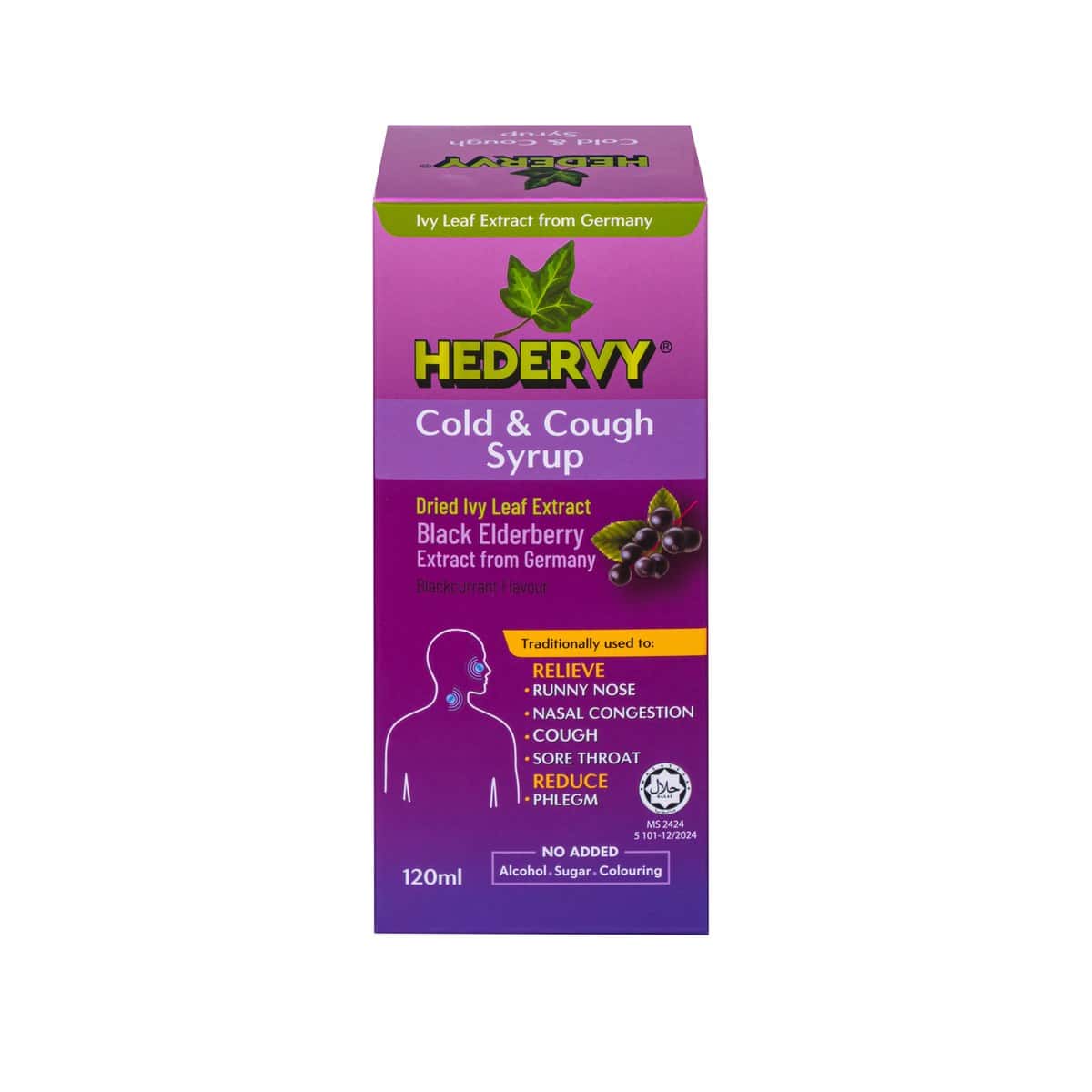
See the range at hedervy.com, or use the pharmacy locator to find a stockist near you.
References
The numbered sources below correspond to the superscript numbers in the article. Every medical claim is cited to a primary source.
- Abuelgasim H, Albury C, Lee J. Effectiveness of honey for symptomatic relief in upper respiratory tract infections: a systematic review and meta-analysis. BMJ Evidence-Based Medicine, 2021;26(2):57–64 (first published online 2020). (14 RCTs; honey improved combined symptom score, cough frequency, and cough severity versus usual care.) https://ebm.bmj.com/content/26/2/57 ↩
- Kuitunen I, Renko M. Honey for acute cough in children — a systematic review. European Journal of Pediatrics, 2023;182(9):3949–3956. (Low-quality evidence overall; honey trended toward improving cough frequency and sleep quality versus placebo/no treatment, but most included trials had risk-of-bias concerns.) https://pmc.ncbi.nlm.nih.gov/articles/PMC10570220/ ↩
- Centers for Disease Control and Prevention (CDC). Foods and Drinks to Avoid or Limit — Infant and Toddler Nutrition. (Honey should not be given to infants under 12 months due to the risk of infant botulism from Clostridium botulinum spores; this includes honey in baked or cooked foods.) https://www.cdc.gov/infant-toddler-nutrition/foods-and-drinks/foods-and-drinks-to-avoid-or-limit.html ↩
- HealthHub Singapore (Ministry of Health). Cough. (Recommends drinking plenty of water, and warm water with honey and lemon, as self-care measures for cough.) https://www.healthhub.sg/health-conditions/cough ↩
- Singh M, Singh M, Jaiswal N, Chauhan A. Heated, humidified air for the common cold. Cochrane Database of Systematic Reviews, 2017, Issue 8, CD001728.pub6. (Six trials, inconsistent results; concluded there was insufficient evidence to recommend steam/heated humidified air for the common cold.) https://www.cochranelibrary.com/cdsr/doi/10.1002/14651858.CD001728.pub6/full ↩
- European Medicines Agency (Committee on Herbal Medicinal Products). European Union herbal monograph on Hedera helix L., folium. (Ivy leaf preparations recognised as “well-established use” expectorant for productive cough, for adults, adolescents, and children from 2 years of age.) https://www.ema.europa.eu/en/medicines/herbal/hederae-helicis-folium ↩
- NHS. Cough. (Most coughs clear within 3–4 weeks; see a GP for a cough lasting more than 3 weeks, or seek urgent help for chest pain, breathing difficulty, or coughing up blood.) https://www.nhs.uk/conditions/cough/ ↩
- HealthHub Singapore (Ministry of Health). Cough. (See a doctor if a cough doesn’t improve within 2 weeks of self-treatment, worsens, or lasts more than 8 weeks; red flags include fever above 38.6°C, thick yellow/green phlegm, bloody or pink frothy phlegm, weight loss, night sweats, and difficulty breathing, wheezing, or chest pain.) https://www.healthhub.sg/health-conditions/cough ↩
Last updated 2026-09-28. This article is for general information only and is not a substitute for medical advice. For severe or persistent symptoms, see a doctor.