

In short: Your cough gets worse at night because four things change the moment you lie down. Mucus stops draining and starts pooling in your throat, stomach acid travels upward more easily, your airways narrow on their natural daily rhythm, and your lungs slow down the process that sweeps mucus out. Nearly every stubborn night cough comes from one of four causes: an infection still clearing, mucus dripping from the nose, asthma, or reflux. Raising the head of your bed, treating phlegm rather than silencing the cough, and keeping the bedroom air from drying out will settle most of them. If your cough hasn’t improved after two weeks of treating it yourself, see a doctor.1
Managing a chesty, phlegmy cough · Which cough syrup for which cough · Find Hedervy at a pharmacy
You get through the day fine. Then you lie down, and within twenty minutes it starts. It settles for a while, wakes you at two, and by the third night you’re wrecked, your partner’s on the sofa, and you’ve started wondering whether something’s actually wrong.
Nothing changed between 3pm and 3am. So why does the same cough behave so differently?
What Happens to Your Cough Between 10pm and 6am
It helps to walk through the night in order, because the cough you get at midnight and the one that doubles you over at six in the morning have different causes.
10pm, the first twenty minutes flat
This is the drainage shift. All day, the mucus your nose and sinuses produce runs downward and you swallow it without ever noticing. Lie down and that drainage stops going anywhere. It collects at the back of your throat instead, sitting directly on the tissue that fires the cough reflex.
Clinical literature calls this gravity-aided pooling of nasopharyngeal secretions, and it’s the biggest single reason a cold-related cough spikes the moment you get into bed.2 If your coughing fit arrives almost on a timer after lights-out, this is usually why.
The muscle at the top of your stomach relaxes on the same schedule. Lying flat reduces the tone of the lower oesophageal sphincter, so acid travels up more easily.2 Plenty of people who cough for this reason have never had heartburn in their lives. The cough is the only sign they get.
2am to 5am, the difficult stretch
Your airways are naturally at their narrowest in the small hours. Airway calibre follows a daily rhythm, and so does vagal nerve tone, which is the nerve pathway that triggers the cough reflex itself.2 Both are working against you at roughly the same time.
This is why so many people describe waking at almost exactly the same hour every night. It isn’t imagination and it isn’t anxiety. It’s a measurable daily cycle, and you’re catching the bottom of it.
6am, everything at once
The tiny hairs lining your airways spend all day sweeping mucus upward and out. That clearance slows down while you sleep, so secretions sit and accumulate rather than moving along.2
Which means the worst cough of the entire illness is often the one that hits you the moment you sit up in the morning, when several hours of accumulation has to come up in one go. It feels alarming — it’s usually the most normal thing about the whole night.
One more, specific to Singapore: an air-conditioner running from eleven to seven strips moisture out of the air for eight hours straight, which dries the throat and thickens whatever mucus is there. It’s a genuinely common contributor here and one of the easiest to change. There’s more on air-conditioning and airways in the guide to blocked nose.
Which of the Four Is Yours?
Almost every persistent night cough traces back to one of these. Working out which one you’ve got matters, because the treatments differ and the wrong one can make things worse.
An infection that’s still clearing
The most common by a distance, and the most reassuring. A cough is the last symptom of a respiratory infection to leave, and it routinely outlasts the runny nose and the fever.
Signs it’s this: it followed an obvious cold, it brings up phlegm, and it’s slowly improving week on week.
The detail that matters is whether the cough is productive, meaning it brings something up, or dry. HealthHub describes phlegm as something your body produces to trap germs and keep the airway moist, and notes that during an infection you make more of it, thicker, needing more effort to shift.1 A productive cough is doing a job. The aim is to help it work better, not switch it off.
Mucus dripping from the nose and sinuses
When your nose and sinuses produce more mucus than usual, it runs down the back of the throat. Doctors group the resulting cough under the term upper airway cough syndrome, and under its older name, postnasal drip, it’s recognised as the single most common cause of a cough that drags on for weeks.3
Signs it’s this: you’re clearing your throat constantly, there’s a tickle at the back of the nose, and the cough is noticeably worse in the first hour after lying down and the first hour after getting up. Our guide to post-nasal drip covers what to do about it.
Asthma
Asthma doesn’t always announce itself with wheezing. In one common form the cough is the only symptom, and it shows up at night or after exercise. Airway inflammation follows a daily cycle that peaks overnight, which is exactly why an asthma cough so often presents as a night cough.2
Signs it’s this: the cough is dry rather than phlegmy, it wakes you consistently rather than occasionally, it worsens with exercise or cold air or dust, or there’s asthma and eczema in the family.
This one needs a doctor — it’s diagnosed with a breathing test and treated with an inhaler, not a syrup.
Acid reflux
The third of the classic three causes of chronic cough, alongside upper airway cough syndrome and asthma.2
Signs it’s this: worse lying flat, worse after a late or heavy dinner, with a sour taste, morning hoarseness, or a persistent lump-in-the-throat feeling. As above, many people with a reflux cough never get classic heartburn, which is why it gets missed for months.
When Singapore Actually Gets Sick
Most health sites will tell you coughs are commoner “in the colder months”, which is not much help in a country that doesn’t have any. So we went and pulled eight years of Ministry of Health polyclinic data to answer it properly for Singapore.
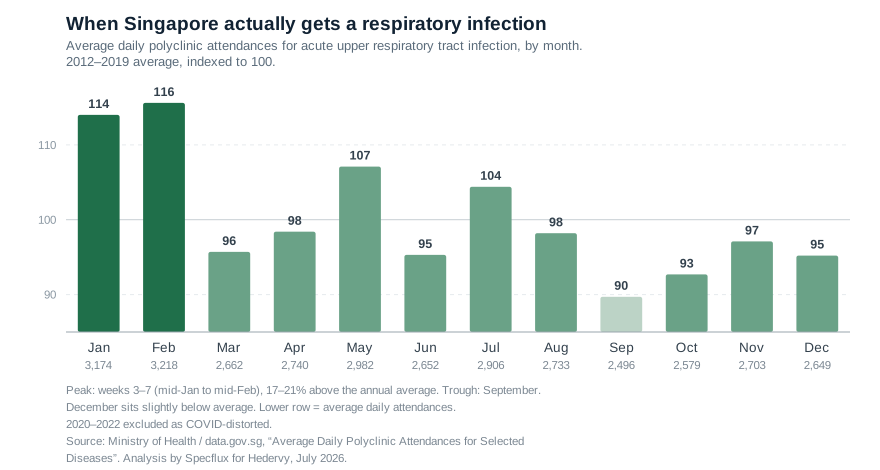
Average daily polyclinic attendances for acute upper respiratory tract infection, 2012–2019 average. The index sets the annual average at 100.
| Month | Average daily attendances | Index |
|---|---|---|
| January | 3,174 | 114 |
| February | 3,218 | 116 (the annual peak) |
| March | 2,662 | 96 |
| April | 2,740 | 98 |
| May | 2,982 | 107 |
| June | 2,652 | 95 |
| July | 2,906 | 104 |
| August | 2,733 | 98 |
| September | 2,496 | 90 (the annual trough) |
| October | 2,579 | 93 |
| November | 2,703 | 97 |
| December | 2,649 | 95 |
The peak is narrow and it’s consistent year after year: epidemiological weeks 3 to 7, so roughly mid-January to mid-February, running 17 to 21% above the annual average.7 September is the quietest month of the year, and there’s a smaller secondary bump around May and July.
The genuinely counterintuitive part is December. It sits slightly below the annual average, despite being the month most people associate with getting ill. Whatever it is that fills Singapore’s polyclinics, it arrives about six weeks after the festive season, not during it.
The pattern still holds. In the first week of February 2026, polyclinics were seeing an average of 2,992 people a day for acute respiratory infection. The same week in 2025 it was 3,392, against a five-year median for that week of 2,795.8
One more thing from the same source, and it surprises people: the commonest respiratory bug in Singapore isn’t influenza. In that February 2026 week, human rhinovirus and enterovirus made up 29% of adult samples and 35% of paediatric samples, ahead of seasonal coronaviruses at 8% and parainfluenza at 5%.8 Rhinovirus is the common cold. Most coughs here are exactly what they look like.
What that means for you. If you’re coughing through late January or February, you’re in the busiest respiratory weeks of the Singapore year, and a cough that’s going round the office is the most likely explanation by some margin. If it’s September and your cough has dragged on for weeks, “something going round” is a weaker explanation, and it’s worth looking harder at the other three causes above, particularly drip and reflux.
Figures are our own analysis of the Ministry of Health series published on data.gov.sg. We excluded 2020 to 2022, since COVID-era attendances don’t describe a normal year.
Tonight: What to Do Before You Go to Bed
Roughly in order of how much difference each one makes.
Three hours before bed, stop eating. If reflux is driving it, this single change settles a lot of night coughs that people had assumed were infection. Go easy on coffee, chilli, fried food and alcohol in the evening if you already know they set your reflux off. HealthHub names coffee, carbonated drinks, alcohol, fried and fatty food, chilli and other spices, and advises against lying down for two hours after eating.1 The wider guideline evidence is that people vary, so it is your own trigger foods that matter rather than a universal list, and the eating-to-bedtime gap does more work than the food list does.9
An hour before bed, deal with the air. Set the air-conditioning a degree or two warmer than you normally would, point the airflow away from the bed, or run a humidifier. A wide bowl of water in the room is a reasonable improvisation if you don’t own one.
Half an hour before bed, take a spoon of honey. Better supported by evidence than most people expect. A Cochrane systematic review of honey for acute cough in children found it moderately better than no treatment for relieving cough and improving sleep quality, for the child and the parent both, and probably better than placebo at shortening how long the cough lasts.4 Fine for adults and for children over one.
A few people should skip it. Never give honey to a baby under one year old. That one is absolute.4 If you have diabetes or are watching your blood sugar, honey is still sugar: Singapore’s own nutrition guidance counts it as added sugar, and a tablespoon carries around 17g of carbohydrate, so it has to fit inside your daily allowance rather than sit outside it.1011 If you have a pollen allergy, particularly to ragweed, mugwort or other daisy-family pollens, honey can occasionally trigger a reaction, because it carries traces of the pollen the bees collected. Reactions are rare, and raw or artisanal honey carries more of this risk than commercial honey, which is filtered and pasteurised so most of the pollen is removed.1213 The same applies if you know you react to propolis. And check the label says pure honey, because cheaper products are sometimes extended with sugar syrups.14 If you are not sure whether honey is right for you, ask your pharmacist.
Clear your nose before you lie down. If mucus is dripping from the nose, rinsing it out before bed removes the material that would otherwise pool in your throat overnight. The post-nasal drip guide explains how to do it properly and what to use.
Take an expectorant, not a suppressant, if you’re bringing up phlegm. This is the mistake that costs people the most sleep. A suppressant traps mucus in the airways overnight, and you wake at four having to shift the lot in one miserable go. An expectorant thins the mucus so each cough clears more of it, which means fewer coughs.
HealthHub puts the two classes side by side: suppressants reduce the body’s urge to cough, while expectorants and mucolytics work by thinning the phlegm.1 Match the class to the cough and you’ll sleep — get it backwards and you won’t.
Raise the head of the bed, not your head. Stacking pillows bends your neck and usually makes things worse. Put a folded towel or a couple of paperbacks under the two legs at the head end so the whole mattress sits on a gentle slope. It’s the highest-impact physical change you can make for both drip and reflux, because it keeps working all night instead of for the twenty minutes before your pillows collapse.
Warm fluids in the evening. Warm water, ginger tea or clear soup thins mucus from the inside. Skip anything ice-cold while you’re congested.
Three Things That Make It Worse
Reaching for a suppressant by reflex. Cough medicines split into two opposite categories and taking the wrong one actively works against you. Suppressants are for a genuinely dry, hacking cough with nothing to bring up. If you’re producing phlegm, you want the other kind. The cough syrup guide walks through which is which.
Using a decongestant nasal spray night after night. They work beautifully for two or three days and then start causing the congestion they were supposed to relieve. It’s a rebound effect called rhinitis medicamentosa, and it comes from using topical decongestant sprays for more than a few days.5 Saline sprays carry no such risk. There’s a fuller explanation in the blocked nose guide.
Assuming green phlegm means antibiotics. Colour is a poor guide to whether an infection is bacterial, and most coughs are viral anyway. We went through this properly in what green phlegm means.
Red Flags
Most night coughs are a nuisance rather than a warning. These are the ones that aren’t. HealthHub advises seeing a doctor if your cough hasn’t improved after two weeks of treating it yourself, if it’s getting worse, or if it’s run past eight weeks, and to seek attention sooner for any of the following:1
Coughing up blood, a large volume of phlegm, or pink frothy phlegm. Any amount of blood counts, including streaks.
Difficulty breathing, wheezing, or chest pain. These change the picture. Go the same day, and to A&E if the breathlessness is significant. If your chest hurts only when you cough and you can reproduce the pain by pressing on it, that’s usually a strained chest wall rather than a lung problem, and we cover it in chest pain when coughing.
Fever above 38.6°C, night sweats, or unexplained weight loss alongside the cough.
Thick yellow or green phlegm that isn’t settling.
A child under two with a persistent cough, or any child who started coughing suddenly after choking on food or a small object.
If you already have asthma, COPD or heart failure and the night cough isn’t following its usual pattern, treat that as a reason to call your doctor rather than to wait it out.
For anything non-urgent in Singapore, a polyclinic is the subsidised route, with private GPs and telehealth as faster alternatives. Severe breathlessness or chest pain means A&E, not an appointment.
Questions People Ask About Night Coughs
Why do I only cough at night and not during the day?
Four things change when you lie down. Mucus pools at the back of your throat instead of draining, stomach acid travels up more easily, your airways narrow on their daily cycle in the small hours, and the mechanism that clears mucus from your lungs slows during sleep. A cough that barely registers while you’re upright becomes obvious once all four line up.
How do I stop coughing long enough to fall asleep?
Raise the head of the bed on a slope, take honey in warm water half an hour before bed (see the cautions above if you have diabetes or a pollen allergy, and never for a baby under one), keep the room from drying out, and if you’re bringing up phlegm, take an expectorant rather than a suppressant. Clearing your nose before you lie down helps if mucus is dripping.
Should I take cough syrup before bed?
Yes, as long as you match the type to the cough. For a productive, phlegmy cough, an expectorant taken in the evening thins the mucus so you clear it in fewer, more effective coughs. For a genuinely dry cough with nothing coming up, a suppressant is the right choice. Taking a suppressant for a chesty cough is the common error, and it usually makes the morning worse.
How long should a night cough last?
A cough after a cold commonly lasts two to three weeks once the other symptoms have gone. That’s normal. What isn’t normal is a cough that hasn’t improved after two weeks of self-treatment, one that’s getting worse, or one still going at eight weeks.1
Why is my cough worse at 3am?
Airway calibre and vagal nerve tone both follow a daily rhythm that reaches its least helpful point in the small hours, and by then several hours of secretions have collected in airways that are clearing themselves more slowly than usual.
Can air-conditioning make a night cough worse?
Yes. It pulls moisture out of the air, and dry air dries the throat and thickens mucus so it’s harder to shift. Raising the temperature slightly, redirecting the airflow away from the bed, or running a humidifier all help.
My child coughs at night but seems fine during the day. Is that normal?
It’s common, and it usually follows a cold. For children over one, and never under one, honey before bed has decent evidence behind it for night-time cough and sleep quality, though see the cautions above if there is a pollen allergy in the family.4 For children two and above with a phlegmy cough, an ivy leaf syrup is a common choice in Singapore. See a doctor for any child under two with a persistent cough, a wet cough lasting more than four weeks, or coughing that started suddenly after choking.
Where a cough syrup helps, and where it doesn’t
If your night cough is chesty and productive, the useful thing a syrup can do overnight is thin the mucus so your body clears it in fewer coughs. That matters more at night than at any other time, because clearance slows while you sleep and secretions accumulate.
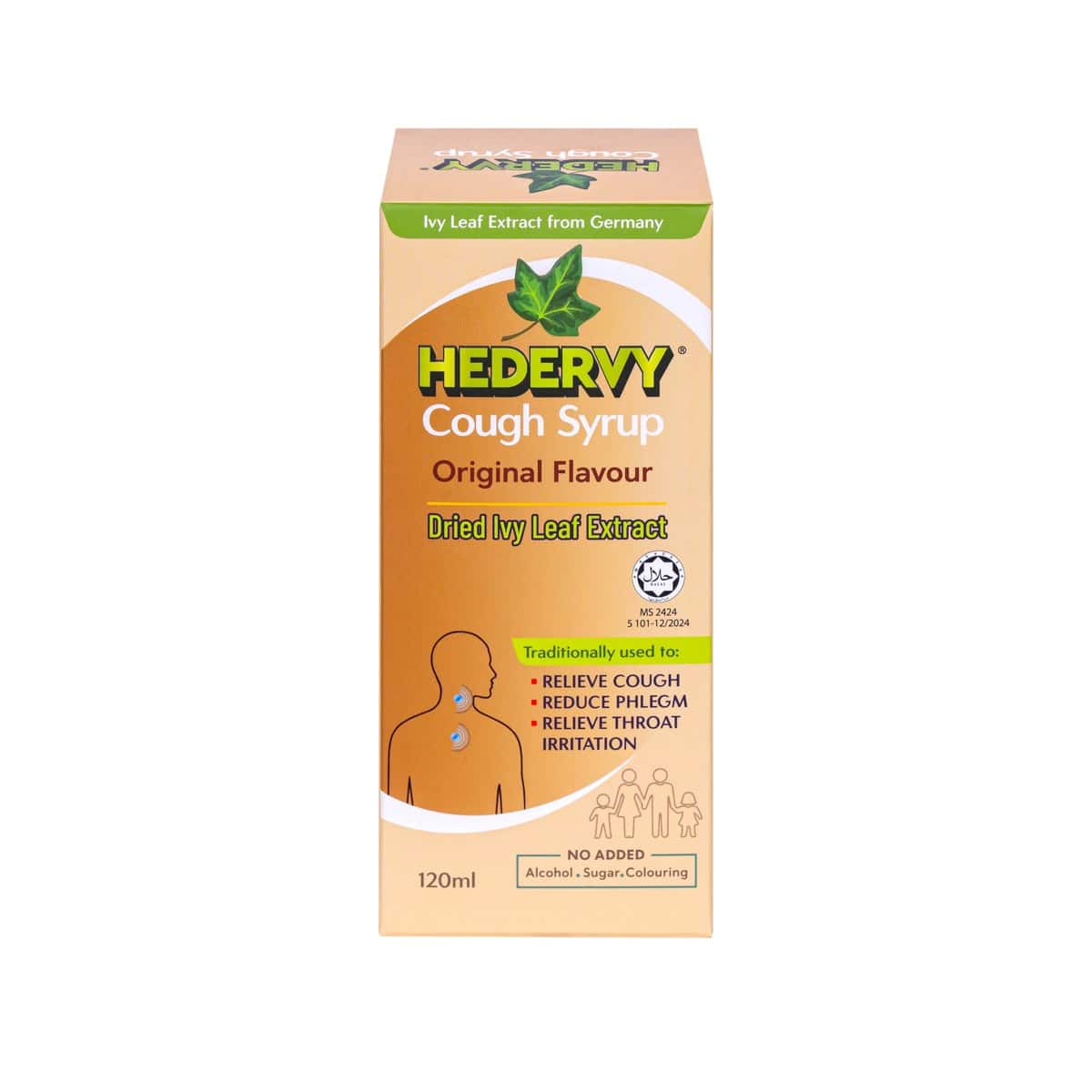
Ivy leaf extract (Hedera helix) is a plant-based expectorant recognised by the European Medicines Agency for productive cough in adults, adolescents and children from two years of age.6 It’s the active ingredient in Hedervy Original and Apple Flavour Cough Syrup, and in Hedervy Cold & Cough Syrup, which pairs it with Black Elderberry. All are Halal-certified (MS 2424), with no added alcohol, sugar or artificial colouring.
If your night cough is dry rather than chesty, an expectorant isn’t the right product. Ask a pharmacist about a suppressant, and see a doctor if it persists, because a dry night cough is one of the ways both asthma and reflux announce themselves.
Find a stockist near you or see the full range.
References
The numbered sources below correspond to the superscript numbers in the article.
- HealthHub Singapore (Ministry of Health). Cough. “Coughing is your body’s way of removing foreign substances and mucus from the lungs and throat.” “If your cough does not get better in 2 weeks with self-treatment, gets worse or lasts for more than 8 weeks, you should see a doctor.” Seek medical attention for cough with thick yellow or green phlegm, fever higher than 38.6°C, weight loss, coughing out a large amount of phlegm or bloody or pink frothy phlegm, night sweats, or difficulty breathing, wheezing or chest pains. “Phlegm is produced by the body to trap germs and keep the airway moist”; during infections “more phlegm is produced, which may be thicker and need more effort to expel”. “Cough suppressants may be taken to reduce the body’s urge to cough”; “Expectorants and Mucolytics may help by thinning the phlegm.” https://www.healthhub.sg/a-z/diseases-and-conditions/cough ↩
- Stanley SM, et al. Nocturnal Cough. StatPearls [Internet]. Treasure Island (FL): StatPearls Publishing. Recumbency exacerbates cough by increasing postnasal drainage and reflux, redistributing airway secretions, and reducing nocturnal mucociliary clearance. Mechanisms listed include gravity-aided pooling of nasopharyngeal secretions in upper airway cough syndrome, decreased lower oesophageal sphincter tone in GERD, and circadian variation in vagal tone and airway calibre in asthma. In adults with a normal chest radiograph the dominant causes are upper airway cough syndrome, cough-variant asthma and GERD. https://www.ncbi.nlm.nih.gov/books/NBK532273/ ↩
- Pratter MR. Chronic upper airway cough syndrome secondary to rhinosinus diseases (previously referred to as postnasal drip syndrome): ACCP evidence-based clinical practice guidelines. Chest, 2006;129(1 Suppl):63S–71S. PMID 16428694. The American College of Chest Physicians committee recommends the term “upper airway cough syndrome” in preference to “postnasal drip syndrome”, and identifies it as the most common cause of chronic cough. https://pubmed.ncbi.nlm.nih.gov/16428694/ ↩
- Oduwole O, Udoh EE, Oyo-Ita A, Meremikwu MM. Honey for acute cough in children. Cochrane Database of Systematic Reviews, CD007094. Honey was moderately better than no treatment for relief of cough and for quality of sleep for children and parents, and probably reduces cough duration better than placebo. Honey should never be given to infants under 1 year. https://www.cochranelibrary.com/cdsr/doi/10.1002/14651858.CD007094.pub5/full ↩
- Rhinitis Medicamentosa. StatPearls [Internet]. Rebound congestion caused by inflammation of the nasal mucosa from excessive use of topical nasal decongestants, arising when decongestant sprays are used for more than a few days. https://www.ncbi.nlm.nih.gov/books/NBK538318/ ↩
- European Medicines Agency (Committee on Herbal Medicinal Products). European Union herbal monograph on Hedera helix L., folium. Ivy leaf preparations are recognised as an expectorant for productive cough, for adults, adolescents and children from 2 years of age. https://www.ema.europa.eu/en/medicines/herbal/hederae-helicis-folium ↩
- Ministry of Health, Singapore. Average Daily Polyclinic Attendances for Selected Diseases. Published on data.gov.sg, resource d_5d5508f1c954f5630d7b3aa7875d01f9. Weekly series, 2012-W01 to 2022-W52, covering acute upper respiratory tract infections. Monthly index and peak-week figures in this article are our own analysis of that series, using the eight pre-pandemic years 2012–2019. https://data.gov.sg/dataset/average-daily-polyclinic-attendances-selected-diseases ↩
- Communicable Diseases Agency, Singapore. Weekly Infectious Disease Bulletin, Epidemiological Week 5, 1–7 February 2026 (Vol. 21 No. 5). “The average daily number of patients seeking treatment in the polyclinics for ARI was 2992 (over 5.5 working days) in E-week 5.” Acute upper respiratory infections: 2,992 in 2026, 3,392 in the same week of 2025, five-week median 2,795 for 2021–2025. Top respiratory pathogens in E-week 5 — adult samples: human rhinovirus/enterovirus 29%, non-SARS seasonal coronaviruses 8%, parainfluenza viruses 5%; paediatric samples: human rhinovirus/enterovirus 35%, parainfluenza viruses 14%, human metapneumovirus 11%. https://www.cda.gov.sg/resources/weekly-infectious-diseases-bulletin-2026/ ↩
- Katz PO, Dunbar KB, Schnoll-Sussman FH, Greer KB, Yadlapati R, Spechler SJ. ACG Clinical Guideline for the Diagnosis and Management of Gastroesophageal Reflux Disease. American Journal of Gastroenterology, 2022;117(1):27–56. “We suggest avoidance of ‘trigger foods’ for GERD symptom control” (conditional recommendation, low quality of evidence); “We suggest avoiding meals within 2–3 hr of bedtime”; “We suggest elevating head of bed for nighttime GERD symptoms.” The guideline notes that alcohol, chocolate, peppermint and high-fat foods reduce lower oesophageal sphincter pressure, while coffee, caffeine, citrus and spicy foods have little to no effect on sphincter pressure and may instead irritate the oesophagus. https://pmc.ncbi.nlm.nih.gov/articles/PMC8754510/ ↩
- World Health Organization. Healthy diet (fact sheet). “Free sugars include monosaccharides and disaccharides (e.g. sucrose, fructose, glucose) added to foods and beverages by the manufacturer, cook or consumer, and sugars naturally present in honey, syrups, fruit juices and fruit juice concentrates.” WHO recommends limiting free sugars to less than 10% of total daily energy intake, with a further reduction to 5% or less for additional health benefits. https://www.who.int/news-room/fact-sheets/detail/healthy-diet ↩
- HealthHub Singapore (Health Promotion Board). Reduce Your Salt and Sugar Intake. “Added sugar can be found in sweetened drinks, fruit juices, honey, jam and processed foods like canned fruits.” The recommended limit for most adults is about 10 teaspoons (50g) of sugar a day on a 2,000-calorie intake, with a further reduction to 5 teaspoons (25g) for additional health benefit. https://www.healthhub.sg/programmes/nutrition-hub/eat-less ↩
- Matuszewska-Mach E, Borysewicz P, Králak J, Juzwa-Sobieraj M, Matysiak J. Ensuring the Safe Use of Bee Products: A Review of Allergic Risks and Management. International Journal of Molecular Sciences, 2025;26(24):12074. “Individuals allergic to airborne pollen may experience systemic reactions upon consuming honey containing the same pollen allergens”; sensitisation “is usually connected to pollen from the large Asteraceae (Compositae) family”, including mugwort, ragweed, sunflower and dandelion. Honey “should not be given to children under 12 months of age”. Propolis “can induce both delayed-type (type IV) and immediate-type (type I) hypersensitivity reactions”. https://pmc.ncbi.nlm.nih.gov/articles/PMC12732908/ ↩
- Di Costanzo M, De Paulis N, Peveri S, Montagni M, Berni Canani R, Biasucci G. Anaphylaxis caused by artisanal honey in a child: a case report. Journal of Medical Case Reports, 2021;15:235. “Commercial honey is heavily processed due to pasteurization and filtration, which removes most of the pollen.” The child was sensitised to ragweed and mugwort; artisanal honey tested positive on prick-by-prick testing while commercial honey tested negative. “Pediatricians should be aware of the potential risk of severe allergic reactions upon ingestion of honey and bee products, especially in patients sensitized to weed pollens.” https://pmc.ncbi.nlm.nih.gov/articles/PMC8120922/ ↩
- European Commission, Joint Research Centre. From the Hives — EU coordinated action on honey authenticity, published 23 March 2023. 320 honey consignments imported from 20 countries were sampled between November 2021 and February 2022; 147 of them (46%) were “suspicious to be adulterated, which means non-compliant with the general provision of the EU Honey Directive”, which requires that “honey shall not have added to it any food ingredient, including food additives”. The syrups used are now mostly made from rice, wheat or sugar beet. The survey’s analytical methodology has since been the subject of public methodological review. https://joint-research-centre.ec.europa.eu/jrc-news-and-updates/food-fraud-how-genuine-your-honey-2023-03-23_en ↩
Last updated 28 July 2026. This article is for general information only and is not a substitute for medical advice. For severe or persistent symptoms, see a doctor.