

Post-nasal drip is the feeling of mucus running down the back of your throat from your nose and sinuses. Your body makes that mucus constantly, and normally you swallow it without a flicker of awareness. You only notice it when there’s more than usual or when it’s got thicker. A cold, allergies, sinus inflammation, dry air-conditioned air or a change in the weather will all do it. It’s also the most common reason a cough carries on for weeks after everything else has cleared up. Rinsing the nose with saline, drinking more water and treating whatever’s causing the extra mucus will settle most cases.
Why coughs get worse at night · How to clear phlegm · Find Hedervy at a pharmacy
Why You’re Clearing Your Throat Every Few Minutes
There’s a particular kind of misery that comes with this. Nothing hurts. You’re not really ill. But there’s a trickle at the back of your throat that never quite stops — you’re clearing it every few minutes, your voice keeps catching in meetings, and it’s been going on for a fortnight.
Most people put up with it far longer than they need to, mostly because it never feels serious enough to bother anyone about.
Here’s what’s actually happening. Your nose and sinuses produce mucus every day whether you’re well or not, and HealthHub describes its job plainly: it traps germs and keeps the airway moist.1 Under normal conditions it drains down the back of your throat and you swallow it on autopilot.
Two things make it noticeable. The volume goes up, or the consistency changes. Thicker mucus moves more slowly and feels like something is sitting there that shouldn’t be.
That reframes what you’re trying to achieve. You’re not trying to stop your body making mucus, which would be a bad idea anyway. You’re trying to get it back to a volume and thickness you stop noticing.
As for what sets it off, a cold or flu virus is the answer more often than everything else put together. Production ramps up while you fight the infection, then takes a week or two longer than the rest of your symptoms to wind back down. If you’re wondering when you’re most likely to catch one, we pulled eight years of Singapore polyclinic data for the night cough guide: the peak is mid-January to mid-February, and December is quieter than people assume.
After that it’s allergies, and in Singapore that generally means dust mites. The tell is timing rather than severity: worst when you wake, worst in the bedroom, sneezing and itchy eyes alongside it, and never a fever.
The rest of the list is shared with a blocked nose, and we have gone through it properly in that guide — inflamed sinuses backing up drainage, air-conditioning drying out the lining, haze and cooking fumes provoking a short-lived spike.
One that catches people out is medication. Some prescriptions increase nasal secretions, as does pregnancy, so mention it to your doctor if the timing lines up with something you have recently started taking.
The Cough Connection
This is the part most people don’t join up, and it’s the reason this article exists.
Mucus pooling at the back of your throat sits directly on the tissue that triggers the cough reflex. So the cough isn’t coming from your chest at all. It’s coming from your throat, in response to something dripping onto it.
This isn’t a fringe explanation. Doctors group it under the term upper airway cough syndrome, and the American College of Chest Physicians identifies it as the most common cause of chronic cough, meaning the coughs that keep going for weeks after the illness that started them has resolved.2
The pattern is easy to spot once you know it. Worse in the first hour after lying down and the first hour after waking, constant throat-clearing, and not much actually coming up during the day. It’s also why a night cough so often turns out to be a nose problem rather than a chest one, which we go through in the guide to coughing at night.
Clearing It, In Order of What Works
Rinse the nose with saline. This is the single most effective thing you can do, and it works mechanically: it physically removes the mucus and the allergens sitting in it. Use a saline spray or a rinse bottle, twice a day, and again before bed if it’s costing you sleep.
Saline irrigation used alongside other treatments improves symptoms and reduces how much medication people end up needing, particularly people with frequent rhinitis, and unlike a decongestant spray there’s no rebound risk at all.3 Two rules: use cooled boiled water or sterile saline, never water straight from the tap, and rinse gently rather than forcing it.
Drink more water than you think you need. Thin mucus drains and gets swallowed. Thick mucus sits and irritates. Hydration is the cheapest way to change the consistency, and it’s the thing most people in air-conditioned offices under-do.
Steam, twice a day. It loosens whatever has thickened and settled, and it costs nothing. Method and timing are in the blocked nose guide.
Sleep on a slope. Keeping drainage moving in the right direction overnight stops it pooling in your throat. There’s a right and a wrong way to do this, and stacking pillows is the wrong way. The method is in the night cough guide.
Treat the allergy if you’ve got one. Weekly hot-wash of bedding, mattress and pillow covers, and a non-drowsy antihistamine from the pharmacy if the pattern fits. This treats the drip at source rather than mopping up after it.
If it’s turned into a chesty cough, treat the mucus. Once the drip has produced a productive cough, one that’s bringing up phlegm, an expectorant is the right class of medicine. HealthHub puts it simply: expectorants and mucolytics work by thinning the phlegm, while suppressants reduce the urge to cough.1 For a chesty cough you want the first kind.
What to avoid: decongestant nasal sprays for more than a few days running. They work well at first and then start causing the congestion they were treating.4 Saline sprays carry no such risk, which is why they’re the ones to reach for repeatedly.
When It’s Not Just Drip
Most post-nasal drip is a nuisance that resolves on its own. Book an appointment if:
- It’s lasted more than two weeks without improving despite treating it yourself1
- The mucus is blood-stained, or you’re coughing up blood
- It’s only on one side, which always warrants a look
- There’s a fever alongside pain across the cheeks or forehead, which can mean a sinus infection that needs treating
- You have difficulty swallowing, or food feels like it catches
- There’s breathlessness or wheezing with it
A polyclinic is the subsidised option in Singapore, with private GPs and telehealth as faster routes. One-sided or persistent symptoms are usually referred on to an ENT specialist.
Straight Answers
How long does post-nasal drip last?
After a cold, usually one to two weeks past the point the other symptoms clear, and the cough that comes with it can run to three. Allergy-driven drip lasts as long as the exposure does, so it can go on for months if nobody addresses the trigger.
Why is it worse in the morning?
Mucus drains backwards and pools while you’re lying flat, so the first hour after waking is when you deal with everything that collected overnight. Sleeping on a slope and rinsing before bed both cut it down.
Can it cause a sore throat?
Yes. Constant mucus flowing over the throat, plus all the throat-clearing it provokes, irritates the tissue directly. The soreness settles once the drip does. A sore throat with a high fever and no runny nose is a different problem and should be looked at.
Does it cause bad breath?
It can. Mucus sitting at the back of the throat gives bacteria something to feed on. Rinsing, hydration and gargling with warm salt water usually sort it out.
Should I take cough syrup for it?
Only if it’s produced a productive cough that’s bringing up phlegm, in which case an expectorant helps by thinning the mucus. If your only symptom is the dripping and the throat-clearing, treat the nose directly instead. A cough medicine has nothing to act on.
A note on Hedervy
Post-nasal drip often ends up as a chesty, phlegmy cough, and that’s the specific job Hedervy is built for. The European Medicines Agency recognises ivy leaf (Hedera helix) as an expectorant for productive cough, cleared for adults, adolescents and children aged two and over.5 What it does is thin mucus so your body can clear it.
If there’s no cough at all, ivy leaf on its own has nothing to act on. Saline and treating the cause are where to start.
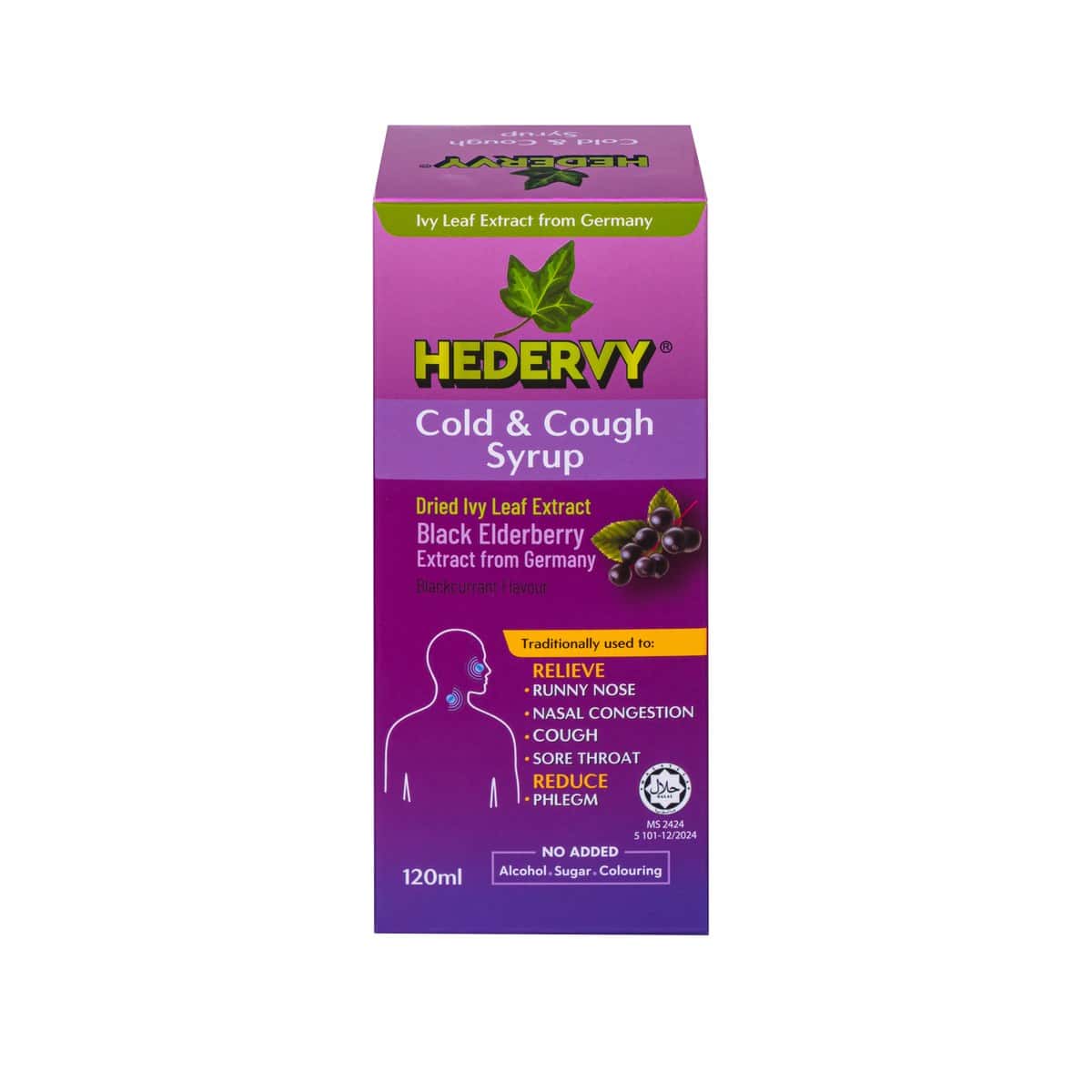
Hedervy Cold & Cough is the one to ask about when the drip comes with a runny or blocked nose. It pairs the same ivy leaf extract with black elderberry, and it’s traditionally used for runny nose and nasal congestion as well as cough, phlegm and throat irritation. Both are for ages two and up. If you’re not sure which fits your symptoms, the pharmacist at the counter can tell you.
References
The numbered sources below correspond to the superscript numbers in the article.
- HealthHub Singapore (Ministry of Health). Cough. (“Phlegm is produced by the body to trap germs and keep the airway moist”; during infections “more phlegm is produced, which may be thicker and need more effort to expel”. “Cough suppressants may be taken to reduce the body’s urge to cough”; “Expectorants and Mucolytics may help by thinning the phlegm.” “If your cough does not get better in 2 weeks with self-treatment, gets worse or lasts for more than 8 weeks, you should see a doctor.”) https://www.healthhub.sg/a-z/diseases-and-conditions/cough ↩
- Pratter MR. Chronic upper airway cough syndrome secondary to rhinosinus diseases (previously referred to as postnasal drip syndrome): ACCP evidence-based clinical practice guidelines. Chest, 2006;129(1 Suppl):63S–71S. PMID 16428694. (The American College of Chest Physicians recommends the term “upper airway cough syndrome” in preference to “postnasal drip syndrome”, and identifies it as the most common cause of chronic cough.) https://pubmed.ncbi.nlm.nih.gov/16428694/ ↩
- Rhinitis Medicamentosa. StatPearls [Internet]. Treasure Island (FL): StatPearls Publishing. (Nasal saline irrigation used as an adjunctive measure may improve symptoms and reduce medication use, particularly in patients with frequent rhinitis.) https://www.ncbi.nlm.nih.gov/books/NBK538318/ ↩
- Rhinitis Medicamentosa. StatPearls [Internet]. (Rebound congestion caused by inflammation of the nasal mucosa from excessive use of topical nasal decongestants, arising when decongestant sprays are used for more than a few days; saline sprays without a decongestant do not cause it.) https://www.ncbi.nlm.nih.gov/books/NBK538318/ ↩
- European Medicines Agency (Committee on Herbal Medicinal Products). European Union herbal monograph on Hedera helix L., folium. (Ivy leaf preparations are recognised as an expectorant for productive cough, for adults, adolescents and children from 2 years of age.) https://www.ema.europa.eu/en/medicines/herbal/hederae-helicis-folium ↩
Last updated 25 August 2026. This article is for general information only and is not a substitute for medical advice. For severe or persistent symptoms, see a doctor.